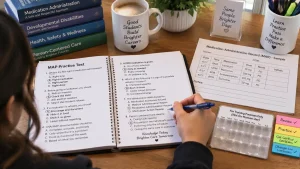

Failing the MAP test stings, especially after you spent time getting ready for it. Here is something that should take the edge off: it happens to a lot of people. State data shows fewer than half of candidates pass the knowledge test on their first attempt, and the skills test fails a good share of people too. Failing does not mean you are out of options. Massachusetts has a clear retake process, and knowing exactly how it works changes how you walk into the next attempt.
What the MAP Test Measures
The MAP competency test checks if you can safely and accurately administer medications in a residential or day program. It is not a general knowledge quiz. It covers reading a Medication Administration Record, measuring liquid doses, giving medications with the right technique, and documenting correctly.
Since February 2023, the test has two components: a written knowledge test and a hands-on medication administration skills test. Transcription used to be a third tested component, but the state moved it out of certification testing and into separate training you complete after you are certified. You have to pass both current components to be listed on the Massachusetts MAP Registry. If you pass one and fail the other, you only retake the part you did not pass, which is worth knowing before you plan your next step. For the full walk-through of the exam format, see what happens in a MAP class.
Why People Fail
On the written test, the usual trouble spots are MAR reading, dosage math, and the rules around documentation and error reporting. On the skills test, nerves do the most damage. Students who freeze during the demonstration or rush through steps without finishing them tend to lose points on technique rather than knowledge. Figuring out which side tripped you up is the first thing to sort out before you plan a retake.
The Retake Rules in Massachusetts
Testing runs through D&S Diversified Technologies on the TMU system, under the state MAP program. A few rules shape your retake, and they are specific.
You have three months from the date you finish MAP training to pass both test components. If you do not pass within that window, you have to retake the full training before you can test again. This timeline used to be six months, so do not rely on older information you may have seen.
Funded candidates through DDS, DMH, DCF, or MassAbility get up to three attempts at each component, paid by the sponsoring agency, and you can only use one funding source. The MAP certification requirements cover the eligibility and funding side in full. If you go through a new training program after using up your attempts, you retest on both components, even the one you passed before.
If you are paying on your own and you fail the knowledge test, you can usually rebook through TMU after 6:00 PM the next business day, pay the retake fee, and pick a new date. For the medication administration skills retake, sponsored candidates need their employment re-verified before scheduling again. As of the latest fee schedule, the knowledge retake runs about $55 and the medication administration retake about $100, though fees change, so confirm the current amount when you rebook.
Your training program or sponsor is the first call after a failed attempt. They can see your results and tell you the exact next step based on your score breakdown.
Read Your Score Report First
When you fail, you get information on which areas fell below the passing line. Do not skim past it. That report is your plan for the retake. If the written score was low, you know where the study hours go. If the skills demonstration was the problem, you need hands-on practice, not more reading. Some students review everything evenly and spread themselves too thin. Hit the weak spots first, get those solid, then revisit the areas you already handled well.
How to Prepare Differently the Second Time
A second attempt is not about studying harder. It is about studying differently.
Start with the Massachusetts MAP curriculum manual. If you do not have a current copy, your training program can provide one. Read the sections tied to your failed areas slowly, since the test draws its language straight from that source. Work medication math problems until the process feels automatic. Many students lean on formulas they memorized in training, and under test pressure that memorization slips. Repetition until the steps feel natural holds up better on test day. A refresher on safe technique also helps, and the common slips are laid out in medication errors and how MAP training prevents them.
Practice the Skills Demonstration Out Loud
If the skills test was where you lost points, practice the physical steps, not just the mental review. Run the full process out loud, in order, the way you would during the test: the MAR check, the preparation, the administration, and the documentation. Ask your training program if they offer supervised practice for students preparing for a retake. Many do.
What to Do Between Now and the Retake
Keep your materials organized so you are not hunting for study guides at the last minute. Set aside a block each day for review instead of cramming right before the date. Talk to your instructor about the parts that gave you trouble, since they have coached students through the same spot and can explain a concept a different way until it lands.
Managing the Pressure
The mental side of a retake is real. Some students pile so much pressure on themselves after a first failure that nerves become the actual obstacle the second time. Go in with a clear, step-by-step mindset. Remind yourself that you already know the format now in a way you did not before, and that familiarity works in your favor.
After You Pass
Once you clear the retake, your MAP certification lets you administer medications in Massachusetts residential programs, DDS-funded settings, and community support environments. The certification is the same no matter how many attempts it took. If it turns out you need the full training again before your next test, you can enroll in a MAP class in Stoughton and reset from there. The extra attention you gave your weak areas often means you finish knowing the material more thoroughly than someone who passed on the first try, and that shows up in the day-to-day work the certification prepares you for.