Phlebotomy is one of the fastest ways into a healthcare career – and in Massachusetts, the path is shorter than most people expect. There’s no state license to chase, programs are measured in weeks rather than years, and demand for skilled blood-draw professionals stays steady across the state’s hospitals and labs. Here’s exactly how to get certified, and how to do it quickly.
The key thing to know: Massachusetts doesn’t license phlebotomists
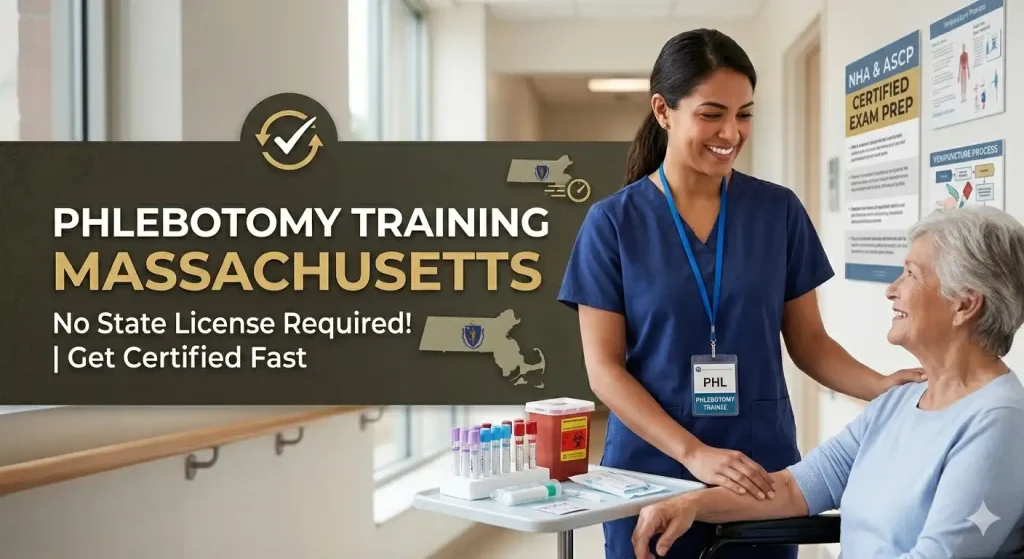
This is the single most important fact for anyone starting out. Massachusetts does not require a state license to work as a phlebotomist – unlike states such as California or Nevada. Instead, the state relies on employer-driven requirements: hospitals, clinics, and labs generally prefer or require candidates who have completed a recognized training program and earned a national certification.
- You can enter faster, because there’s no state licensing exam or application to clear.
- Certification still matters, because most employers treat a national credential as proof of competence. Skipping it narrows your options significantly.
Step 1: Meet the basic eligibility requirements
- You’re at least 18 years old.
- You have a high school diploma or GED.
No prior healthcare experience is required for entry-level programs – though if you’re already a CNA, HHA, or other certified worker, some accelerated programs are built for you. Not sure which entry role fits? Compare it with the patient care technician role, which often includes phlebotomy.
Step 2: Complete a phlebotomy training program
This is where fast comes in. Most phlebotomy programs in Massachusetts run about 4 to 8 weeks, and some specialized workforce programs are even shorter. A good program covers:
- Venipuncture and capillary (fingerstick) collection techniques
- Patient identification and safety protocols
- Specimen handling, labeling, and transport
- Infection control and bloodborne-pathogen safety
- Patient interaction and communication
Hands-on clinical experience is non-negotiable. Quality programs include a clinical rotation or externship where you practice real draws under supervision. It’s also a quiet job-search advantage – students frequently get hired where they did their rotation, so treat your externship like an extended interview.
Step 3: Pass a national certification exam
After training, you sit for a certification exam through a national credentialing organization. The two most widely recognized in Massachusetts are:
- NHA – Certified Phlebotomy Technician (CPT)
- ASCP – Phlebotomy Technician (PBT)
Other recognized bodies include AMT, NCCT, NPA, and ASPT. Before you enroll anywhere, confirm the program makes you eligible to sit for one of these exams.
Step 4: Apply for jobs
Once certified, you’re ready to work. Massachusetts employs roughly 2,930 phlebotomists, with demand concentrated in Boston, Worcester, and Springfield. Typical workplaces include hospitals, diagnostic labs, outpatient clinics, and blood-donation centers.
The outlook is solid: phlebotomist jobs are projected to grow about 8% from 2023 to 2033 nationally, and phlebotomists earn an average of around $50,660 per year based on recent federal data – competitive for a role you can train for in a couple of months.
How fast can you really get certified?
Realistically, a motivated student can go from enrolling to certified in roughly 1-3 months: a 4-8 week program plus the time to schedule and pass your exam. The fastest paths choose an accelerated program with a built-in externship, book the certification exam as soon as eligible, and – for existing healthcare workers – use shorter bridge-style courses.
Keeping your certification active
National phlebotomy certifications generally need renewal every two years, usually by completing continuing-education (CE) credits and paying a fee. Requirements vary by body – the NHA, for instance, asks for around 10 CE credits, and renewal fees across organizations tend to run from about $50 to $179.
How phlebotomy compares to other entry-level healthcare roles
Phlebotomy is one of several fast on-ramps into Massachusetts healthcare, and it pairs naturally with other direct-care credentials – in fact, patient care technicians often perform phlebotomy as part of a broader role. If you’re weighing your options:
- Phlebotomy – narrow, technical, lab-focused; fast to train for.
- CNA – broad patient care and the most common entry point into clinical work, and a stepping stone toward LPN/RN.
- HHA – one-on-one, community-based care in patients’ homes.
For pay context, compare the CNA salary and job outlook in Massachusetts, and if English is your second language, read how others found CNA/HHA success in Massachusetts. Many people stack credentials like BLS certification to widen their options.
Frequently asked questions
Do you need a license to be a phlebotomist in Massachusetts?
No. Massachusetts doesn’t license phlebotomists, and certification isn’t legally required either – but most employers expect a national certification, so it’s effectively required to get hired.
How long does phlebotomy training take in Massachusetts?
Most programs run about 4-8 weeks, with some accelerated options shorter. Including the exam, many people are working within 1-3 months.
Which phlebotomy certification is best in Massachusetts?
The NHA (CPT) and ASCP (PBT) are the most widely recognized by Massachusetts employers, though several national credentials are accepted.
How much do phlebotomists make in Massachusetts?
Nationally, phlebotomists average around $50,660 per year per recent federal data, varying by location, employer, and experience.
Can a CNA or HHA become a phlebotomist quickly?
Often, yes. Some Massachusetts programs are designed for people already working in a certified healthcare role and can be completed faster.
Start your healthcare career in Massachusetts
Phlebotomy is a fast, practical entry into healthcare – and rarely the end of the road. While we don’t currently offer phlebotomy training, our CNA program and Home Health Aide program in Stoughton are among the strongest entry points into Massachusetts healthcare – and a natural complement to phlebotomy skills. Explore our healthcare training programs to find the right starting point.
This article is for general informational purposes. Certification requirements and figures change, so confirm current details with your chosen certifying body before enrolling.