Most people freeze when someone collapses because they think CPR is complicated and they are scared of doing it wrong. Hands-only CPR removes that fear. It is two steps, no mouth-to-mouth, and for an adult who suddenly collapses it can be as effective as full CPR in those first critical minutes. Knowing it means you can act instead of waiting.
A note first: this article helps you understand and remember hands-only CPR. It is not a substitute for a hands-on class, where you practice the depth and rhythm on a manikin. Learn it properly before you need it.
The Two Steps
| Step | What to Do |
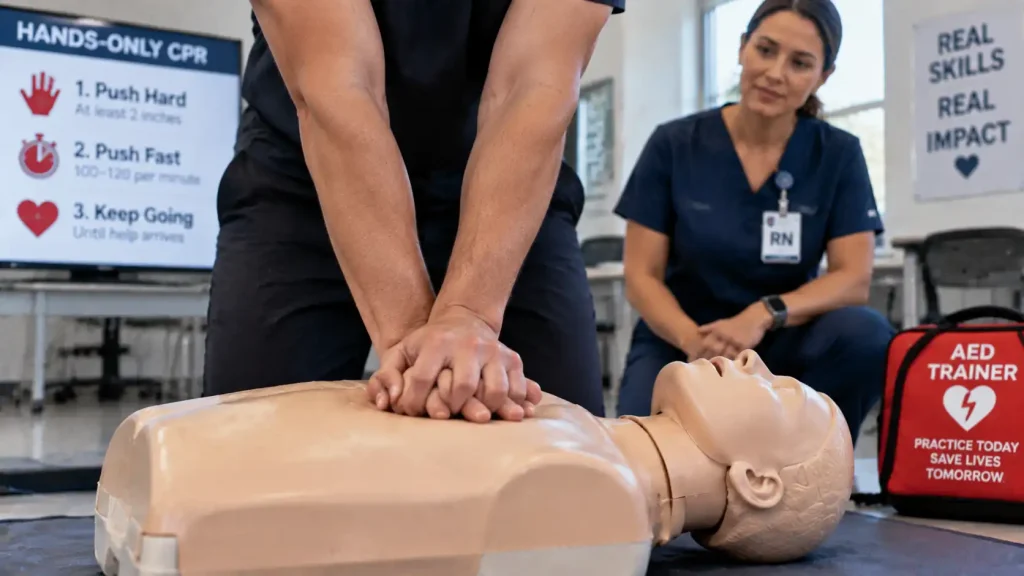
| 1 | Call 911. If you see a teen or adult suddenly collapse and they do not respond, call 911, or better, have someone else call while you start. If an AED is nearby, send someone to get it. A 911 dispatcher can coach you through it |
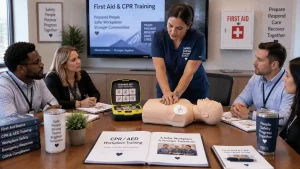
| 2 | Push hard and fast in the center of the chest. Place the heel of one hand in the center of the chest, your other hand on top, and press down about two inches at a rate of 100 to 120 pushes per minute. Let the chest come all the way back up between pushes, and do not stop until help arrives |
That is it. No rescue breaths, no complicated sequence. Two steps.
The Rhythm Trick
The right speed is 100 to 120 compressions a minute, which is faster than most people expect. The classic way to keep the beat is to push to the rhythm of the song Stayin Alive. Other songs at a similar tempo work too. The point is to push hard, push fast, and keep going.
When to Use Hands-Only CPR
- An adult or teen suddenly collapses in front of you
- They are unresponsive when you tap them and shout
- They are not breathing, or only gasping, which is not normal breathing
- You are not trained in full CPR, or you are not confident giving rescue breaths
In these situations, doing hands-only CPR is far better than doing nothing while you wait for the ambulance. Bystander CPR can double or triple a person chance of survival.
When Hands-Only CPR Is Not the Right Choice
Hands-only CPR is designed for sudden collapse in adults and teens. It is not the answer for every situation.
- Infants and young children: their emergencies more often start with a breathing problem, so they need rescue breaths. See our infant CPR guide
- Drowning, drug overdose or choking-related collapse: these are breathing-first emergencies where rescue breaths matter, so full CPR is preferred if you are trained
- Someone who is coughing, moving or breathing normally: do not start compressions on a person who is responsive
If you are trained and willing, full CPR with breaths is still the standard, especially for children and breathing-related emergencies. Hands-only CPR is the version that removes every excuse not to help an adult.
Why It Works
When an adult has a sudden cardiac arrest, there is still oxygen in the blood. The problem is that the heart has stopped moving it. Chest compressions keep that oxygen-rich blood flowing to the brain and heart until a defibrillator or paramedics arrive. In the first few minutes, keeping blood moving is what buys time, which is why compressions alone can be so effective for an adult.
Do Not Be Afraid
The most common reason bystanders hesitate is fear of hurting the person or doing it wrong. The reality is that a person in cardiac arrest is already in the worst possible situation, and your action can only help. You cannot make it worse by trying. The only wrong move is doing nothing.
Frequently Asked Questions
What are the two steps of hands-only CPR?
Call 911, then push hard and fast in the center of the chest at 100 to 120 compressions per minute until help arrives. No rescue breaths are needed.
How fast should I push?
About 100 to 120 compressions per minute, roughly the beat of the song Stayin Alive. Push about two inches deep and let the chest fully recoil between pushes.
Can I use hands-only CPR on a baby?
No. Infants and young children need rescue breaths because their emergencies usually start with a breathing problem. See our infant CPR guide.
Is hands-only CPR as good as regular CPR?
For an adult who suddenly collapses, it can be as effective as full CPR in the first few minutes. For children and breathing-related emergencies, full CPR with breaths is preferred.
Do I need training to do hands-only CPR?
You can do it untrained, and a 911 dispatcher can coach you. But taking a class builds the confidence and muscle memory that make you act faster and push correctly.
Build Real Confidence in a Class
Reading the steps is a start, but practicing on a manikin is what makes you ready. One Health and Beyond offers hands-on CPR and First Aid certification in Stoughton, serving Brockton, Canton, Randolph, Sharon, Easton and Quincy. Contact us to sign up.