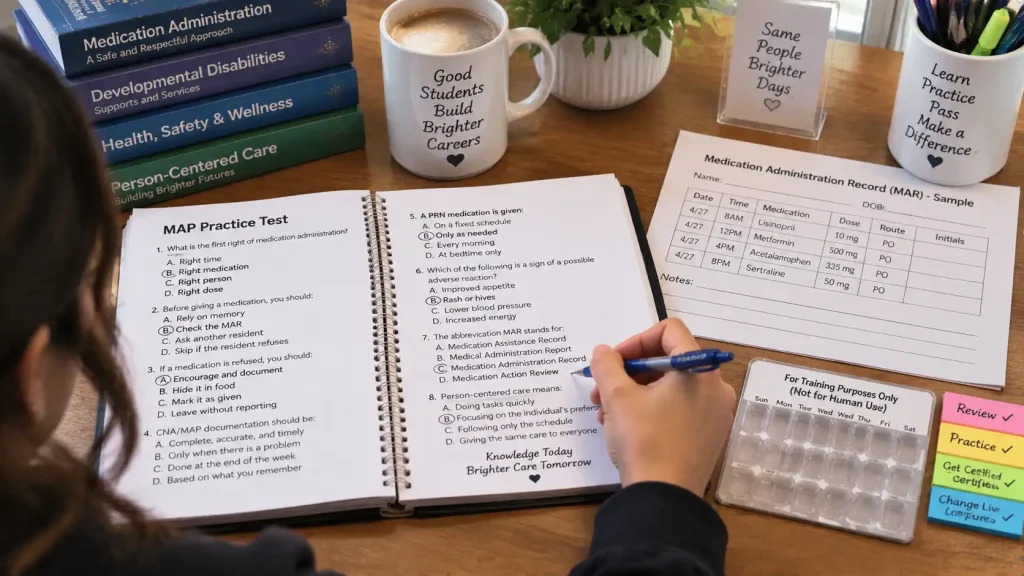
The Massachusetts MAP certification test is what stands between your training and being listed as certified to administer medications. Practicing real-style questions is the fastest way to find your weak spots before test day. The questions below are original practice questions in the same style as the exam, with full explanations so a wrong answer still teaches you something.
A note first: these are practice questions for study only. They are not the real exam, and they will not certify you. Always study the approved Massachusetts MAP curriculum through your MAP trainer, and confirm current testing details through the official testing information.
How the Real MAP Test Works
Understanding the format lowers the stress. In Massachusetts, MAP certification testing is handled by the state contracted testing vendor, not by your training program, and the questions are drawn from the approved MAP curriculum. The test has three components, and you must pass all three to be listed as certified:
| Component | What It Checks |
| Knowledge test | Your understanding of safe medication administration, the rights, documentation, PRN rules, storage and safety |
| Transcription | Accurately transferring a health care provider order onto the medication sheet |
| Medication administration skills | Demonstrating a safe medication pass to a certified tester, following a scenario |
These practice questions focus on the knowledge portion. For the full breakdown, see our guide to the MAP exam format, and for the path to test day see MAP certification requirements.
MAP Practice Questions
Read each question, choose your answer, then check the answer key and explanations in the next section.
- You are about to administer a medication and notice the name on the pharmacy label does not match the name on the medication sheet. Your first action is to:
- Give the medication anyway since it is close
- Stop and check the order and label before giving anything
- Ask another staff member to guess
- Skip the dose and say nothing
- A person you support refuses to take their morning medication. You should:
- Hide it in their food
- Insist until they take it
- Respect the refusal, document it, and report it
- Give a double dose later
- After you give a medication, you should document it:
- At the end of your shift from memory
- Right away, before moving on
- Before you give it, to save time
- Only if there is a problem
- A PRN medication is one that is:
- Given at the same time every day
- Given only when a specific symptom is present, within the order
- Given whenever the person asks, without limit
- Never documented
- You realize you gave a person the wrong dose. Your first action is to:
- Wait and see if anything happens
- Follow your program procedure and contact your MAP consultant or nurse right away
- Erase it from the medication sheet
- Give the correct dose immediately on your own
- Three people are due to receive medications at the same time. You should:
- Pour all of them together to save time
- Prepare and administer each person medications individually
- Let them share the same cup
- Give them to whoever is closest first
- When you make an entry on the medication sheet and realize you made a mistake, you should:
- Scribble it out completely
- Use correction fluid over it
- Follow your program correction method without erasing
- Start a brand new sheet and throw the old one away
- Talking about a person medications and medical condition with someone not involved in their care is:
- Fine if they are family
- A violation of the person privacy and rights
- Required by law
- Only a problem in writing
- A health care provider order says to give 100 mg, and the pharmacy label on the bottle says each tablet is 50 mg. You should give:
- Half a tablet
- One tablet
- Two tablets
- Call it in as an error
- The safest habit to avoid medication errors during a medication pass is to:
- Work as fast as possible
- Rely on your memory of the schedule
- Stay mindful and follow the rights of medication administration every time
- Let another staff member double check only sometimes
Answer Key and Explanations
- Correct answer: B
Any mismatch between the label and the medication sheet is a stop signal. You never give a medication until the order and label are confirmed. This is the right medication and right person check in action.
- Correct answer: C
A person has the right to refuse. You do not hide, force or trick a medication. You document the refusal and report it so the care team can respond.
- Correct answer: B
Document right after you give it, never from memory at the end of the shift and never before giving it. Accurate, timely documentation prevents double doses.
- Correct answer: B
PRN means as needed. It is given only when a specific symptom is present and only within the limits of the order, such as the dose, timing and maximum.
- Correct answer: B
A medication error is a health and safety issue. Follow your program procedure and contact your MAP consultant or nurse right away. Do not hide it or act on your own.
- Correct answer: B
Each person medications are prepared and administered individually. Never pour together or let people share, which is how mix-ups happen.
- Correct answer: C
Follow your program correction method. Never scribble out, use correction fluid, or erase, because the medication sheet is a legal record.
- Correct answer: B
Sharing a person medical information with anyone not involved in their care violates their privacy and rights.
- Correct answer: C
If one tablet is 50 mg and the order is for 100 mg, you give two tablets. Always confirm calculations, and if anything looks off, stop and check.
- Correct answer: C
Staying mindful and running the rights of medication administration every single time is the most reliable defense against errors. Speed and memory are how mistakes happen.
How to Study for the MAP Test
Know the rights of medication administration cold, since they run through the whole test. Understand how to fill out a medication administration record, because documentation and transcription questions come up. Review PRN medication rules. Practice the medication math until it is automatic. And walk through the MAP exam format so nothing on test day is a surprise.
If You Do Not Pass
Not passing on the first try is common and fixable. Focus your study on the areas where you struggled and try again. Our guide on what to do after a failed MAP test walks through the steps back.
Frequently Asked Questions
Is this the real MAP test?
No. These are original practice questions for study only. The real test is administered by the state contracted testing vendor and has three components: knowledge, transcription and a medication administration skills demonstration.
How many components does the MAP test have?
Three: a knowledge test, a transcription task, and a medication administration skills demonstration. You must pass all three to be listed as certified.
What is the best way to study?
Know the rights of medication administration, understand documentation and PRN rules, practice medication math, and take practice questions to find weak spots.
What happens if I fail?
You can retest. Focus on the areas where you were weak. See our guide on what to do after a failed MAP test.
Where do I take the MAP test?
In Massachusetts, testing is conducted by the state contracted testing vendor, not by your training program.
Get MAP Certified in Stoughton, MA
One Health and Beyond prepares direct care staff for the MAP test through our MAP certification training in Stoughton, in person or online and hybrid. Contact us for the next class.