

Alt Text: A healthcare professional in a Massachusetts community program setting reviewing medication administration requirements and documentation.
Before you enroll in a Medication Administration Program, it helps to know exactly what Massachusetts requires of candidates. MAP certification opens access to higher-paying direct care roles across DDS-funded group homes, day programs, and community residences, but the eligibility bar is real. The program operates under Massachusetts Department of Public Health (DPH) regulations at 105 CMR 700.003(F), and testing is administered by D&S Diversified Technologies, the state-approved vendor. Students arrive at our Stoughton campus every month with questions about age limits, background checks, prior certifications, and whether their specific situation qualifies. This guide lays out every MAP certification requirement in Massachusetts so you can confirm eligibility before paying for a class.
Quick answer: Most MAP candidates in Massachusetts need a current CNA or HHA certification, an active CPR or BLS card, a clean CORI background check, a high school diploma or equivalent, and employer sponsorship for the worksite practicum hours. Certification testing is handled through D&S Diversified Technologies (D&SDT) under DPH oversight.
What Is MAP Certification?
The Medication Administration Program is a Massachusetts-specific credential that authorizes direct care workers to administer medications to residents in DDS, DMH, DCF, and MassAbility community programs. It is not a nursing license and does not replace one. It is a scope-limited certification, governed by the DPH MAP Policy Manual, that covers safe medication handling, the five rights of administration, documentation, PRN rules, and error response for non-clinical staff working in community residential and day program settings.
Certification testing is delivered by D&S Diversified Technologies (D&SDT), also known as Headmaster LLP, the state-approved testing vendor. All certified MAP staff in Massachusetts appear on the MAP Registry maintained by D&SDT on behalf of the Commonwealth.
For the full overview of what MAP covers and why it matters for your career, see our MAP certification in Massachusetts landing page.
Core MAP Certification Requirements in Massachusetts
Every MAP candidate must meet a baseline set of requirements before a training program can enroll them. These are the five that come up in nearly every student intake conversation at our Stoughton campus.
1. Minimum Age of 18 Years
MAP candidates must be at least 18 years old at the time of enrollment. This is tied to the legal responsibility involved in medication handling and the employer liability that comes with administering controlled substances. Students under 18 cannot legally sit for the D&S MAP Certification Test or perform practicum hours.
2. High School Diploma or Equivalent
A high school diploma, GED, or HiSET is required. The MAP curriculum involves medication math, written documentation, and transcription of complex medication orders. The literacy and numeracy expectations assume a completed secondary education. Students without a high school credential should complete a GED program before enrolling.
3. Current CNA or HHA Certification
Most MAP programs in Massachusetts require active CNA or HHA certification as a prerequisite. This rule exists because MAP builds on basic patient care skills such as vital signs monitoring, patient communication, and infection control. Students arrive at MAP with those fundamentals already in place, which lets the curriculum focus entirely on medication-specific competencies.
If you have not yet completed a CNA or HHA program, start with our how to become a CNA in Massachusetts guide to build the foundation that leads into MAP.
4. Active CPR or BLS Certification
An active CPR or American Heart Association BLS Provider card is required because medication errors and adverse reactions sometimes trigger emergency response scenarios. You cannot legally administer medications in a DPH-registered MAP site without current emergency response credentials on file. Most students hold a BLS Provider card specifically because it is accepted across more Massachusetts healthcare settings.
For details on why BLS beats basic CPR for direct care workers, read BLS certification for CNAs and HHAs or the full BLS vs CPR comparison.
5. Clean CORI Background Check
Massachusetts requires a CORI (Criminal Offender Record Information) check for every MAP candidate. The background check screens for disqualifying offenses that would prevent you from working with vulnerable populations. Common disqualifiers include violent felonies, sex offenses, abuse or neglect convictions, and certain drug-related felonies. Minor infractions generally do not disqualify you, but every case is reviewed individually by the approving employer under DPH guidelines.
MAP Eligibility Requirements at a Glance
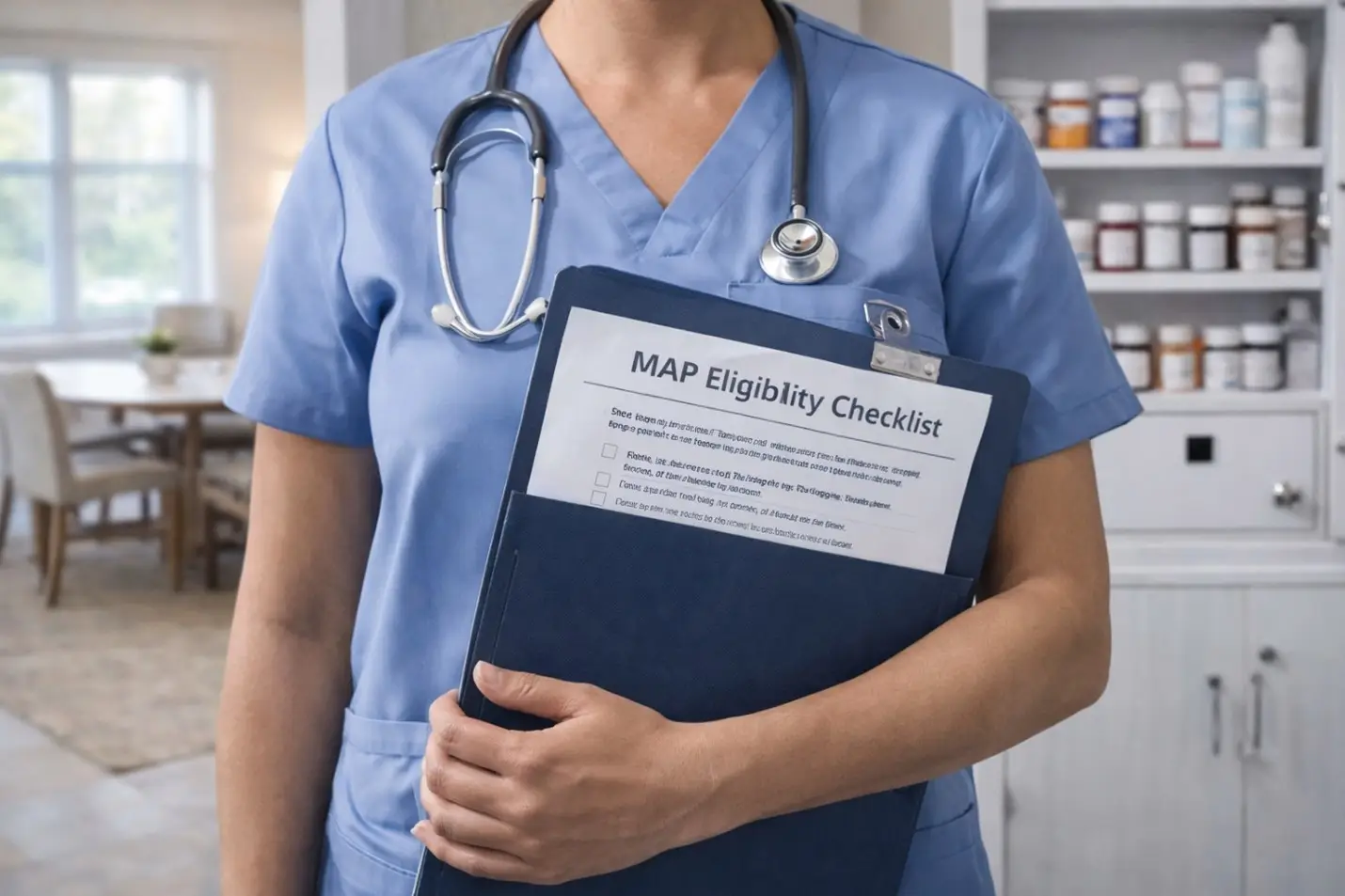
Here is the full eligibility checklist in one place. Check each box before enrolling.
| Requirement | Who Needs It | Notes |
| 18+ Years of Age | All candidates | Verified at enrollment with photo ID |
| HS Diploma or GED | All candidates | Transcripts may be requested |
| CNA or HHA Certification | Most candidates | Active status verified through registry |
| CPR or BLS Card | All candidates | Must be current, not expired |
| CORI Background Check | All candidates | Run by employer under DPH guidelines |
| Employer Sponsorship | For practicum hours | Required for worksite medication passes |
| D&S Test Registration | All candidates | Via TestMaster Universe (TMU) portal |
| TB Test or Physical Exam | Often required | Depends on employer and facility policy |
Understanding the D&S Diversified Technologies MAP Test
Once you complete an approved MAP training program and pass the pretest components, you become eligible to sit for the official MAP Certification Test administered by D&S Diversified Technologies. The test has three components that all candidates must pass to earn certification.
✓ Computer-Based Knowledge Test. A written multiple-choice exam covering medication classifications, administration routes, DPH regulations, and safe handling practices.
✓ Transcription Skills Test. A hands-on evaluation where you correctly transcribe Health Care Provider medication orders onto the MAR (Medication Administration Record).
✓ Medication Administration Demonstration. A one-on-one skills test where a certified tester observes you administer medications based on a given scenario. Maximum test time is 10 minutes.
Candidates have six months from the date of MAP Training completion to pass all three components. If you do not pass within that six-month window, you must retake the full MAP Training before becoming eligible to test again. Employer-sponsored candidates through DDS, DMH, DCF, or MassAbility receive up to three attempts at each component funded by the sponsoring agency.
Ready to Enroll? Document Prep Checklist
Students who walk into MAP enrollment with the following four documents ready skip the most common administrative delays. Gather these before calling to register for a class.
Have These 4 Documents Ready Before You Enroll
1. Copy of High School Diploma or GED. An official copy of your secondary education credential or transcripts.
2. Active CNA or HHA Registry Number. Your current Massachusetts Nurse Aide Registry number, with a verified expiration date.
3. Current AHA BLS Provider Card. Front and back photo of your card, showing the expiration date is more than six months out.
4. Valid Government-Issued Photo ID. Driver’s license, state ID, or passport, showing your current legal name and address.
Students with all four documents prepared typically complete their enrollment in a single visit. Missing documentation can delay the start of your training by several weeks while paperwork is tracked down.
Why Employer Sponsorship Matters
MAP certification is not complete after the classroom portion. You must finish worksite practicum hours where you demonstrate safe medication passes under direct supervision by a registered nurse or approved MAP trainer. This step cannot happen without an active employer placement. Many MAP candidates enroll in training programs only after they have secured a job offer or placement with a DDS-funded agency that will sponsor the practicum.
If you are applying to jobs while still earning MAP, look for postings that specifically state MAP training provided or MAP sponsorship available. Group homes, day programs, and community residences commonly offer this benefit to recruit new staff. DDS, DMH, DCF, and MassAbility-sponsored candidates also have D&S testing fees covered through their sponsoring agency for the first three attempts per component.
What Can Disqualify You From MAP Certification
Massachusetts takes MAP eligibility seriously because medication errors in direct care settings can seriously harm residents. The most common disqualifying factors fall into four categories.
✓ Failed CORI Check. Disqualifying criminal offenses on your record can prevent MAP enrollment or certification. Speak with the approving employer if your record has any flagged items.
✓ Expired Prerequisites. An expired CNA, HHA, CPR, or BLS card stops MAP enrollment until the underlying credential is renewed. Check all expiration dates before applying.
✓ Active Abuse Registry Listing. Candidates listed on the Massachusetts abuse registry cannot enroll in MAP or work with DDS-funded populations.
✓ Incomplete Documentation. Missing transcripts, ID, immunization records, or employer paperwork causes delays that can push back your practicum timeline by weeks.
How to Confirm Your Eligibility Before Enrolling
The fastest way to confirm MAP eligibility is to gather your documents and run through a four-step pre-check. One, verify your current CNA or HHA status through the Massachusetts Nurse Aide Registry or your issuing program. Two, check the expiration date on your CPR or BLS card. Three, pull your own CORI report through Mass.gov to spot potential issues before an employer sees them. Four, confirm your high school diploma or GED paperwork is accessible.
Students who complete this pre-check walk into MAP enrollment smoothly. Students who skip it often face delays of several weeks while missing paperwork is tracked down.
Ready to Enroll in MAP Certification?
If you meet the eligibility requirements above, our Stoughton campus is ready to help you earn your MAP certification on a flexible evening and weekend schedule. See current MAP class dates and reserve your seat today.
Curious about tuition? Review our full breakdown of how much MAP certification costs in Massachusetts. Still deciding whether MAP is the right credential for your scope of work? Read MAP vs LPN: Can You Administer Medications Without a Nursing License?.