
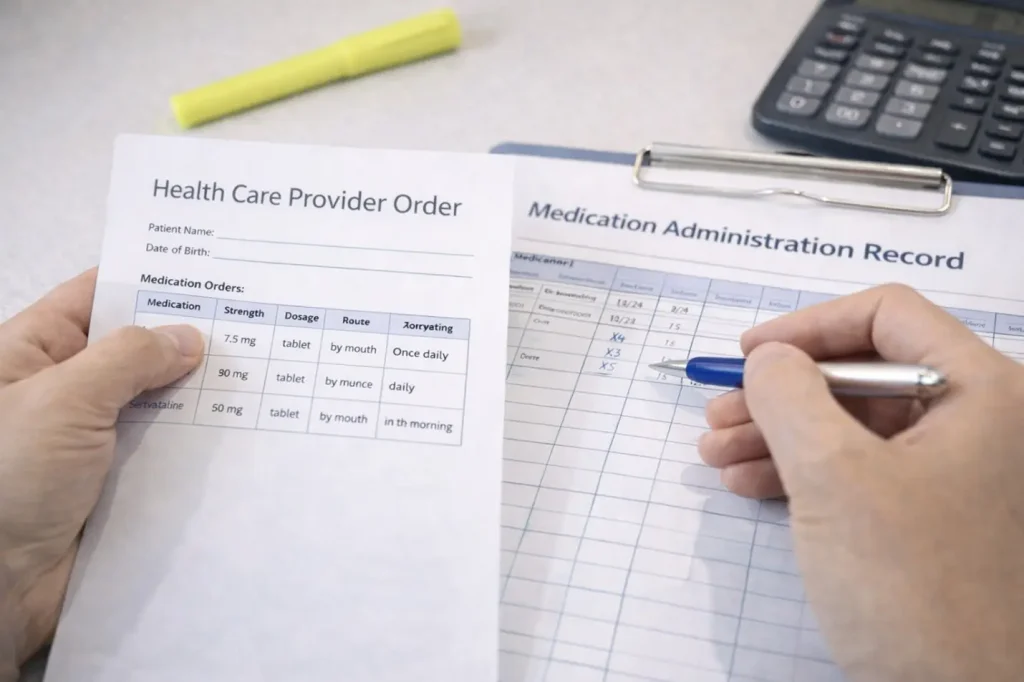
Alt Text: A healthcare student practicing MAP transcription by carefully comparing a Health Care Provider (HCP) order to a Medication Administration Record (MAR).
Most MAP candidates in Massachusetts do not fail the MAP test because they do not know medications. They fail on transcription. The D&S Diversified Technologies transcription component has its own dedicated 15-minute window, its own scoring checklist, and its own reputation as the hardest part of the MAP Certification Test. Miss one required step and you reschedule, not retry. This guide walks through exactly what the transcription task tests, what the D&S checklist looks for, the most common mistakes that cause candidates to fail, and the specific tips that help students pass on the first attempt.
Quick answer: The MAP transcription test is a 15-minute hands-on skills test where you demonstrate the ability to discontinue an existing medication and transcribe a new HCP order onto a Medication Administration Record. Every part of the D&S transcription checklist must be met. Missing any single step means you reschedule.
What MAP Transcription Actually Means
In MAP practice, transcription is the process of taking a written Health Care Provider (HCP) order and accurately copying it onto the Medication Administration Record at the MAP Registered site. It is not administration, and it is not documentation of an administration. Transcription happens before a medication is ever given, and it sets up every medication pass that follows. If the transcription is wrong, every administration that references it will also be wrong.
Massachusetts DPH regulates transcription under Section 08 of the MAP Policy Manual, which covers Health Care Provider Orders, and Section 11, which covers the Medication Administration Record. Two MAP Certified staff must later post and verify every transcription, and before each new month, two certified staff complete an accuracy check by comparing the new MAR against HCP orders and pharmacy labels. This system, known as the Biennial TMM System (Transcription, Posting and Verifying, Monthly accuracy check), exists because transcription errors are a leading root cause of medication errors in direct care.
What the D&S Transcription Test Actually Tests
The transcription component of the MAP Certification Test is administered by D&S Diversified Technologies in a group setting, with each candidate receiving a unique, randomized transcription task. You have 15 minutes to complete the task, and the scoring is strict: the D&S transcription checklist contains a list of required components, and every single one must be demonstrated to pass.
The typical task has two parts. First, you discontinue an existing medication on the MAR using the correct D/C process. Second, you transcribe a new medication from an HCP order onto the medication sheet. Each part has its own checklist items, and missing any item means you must reschedule the transcription test rather than continue with the medication administration demonstration.
Required Components of an HCP Order
Before you can transcribe well, you need to recognize what a complete HCP order contains. Under DPH Circular DCP 20-3-110, every HCP order must be written without medical abbreviations or symbols, and must include the following components.
✓ Individual’s Name. The full legal name of the resident receiving the medication.
✓ Date the Order Was Written. The specific date the HCP wrote and signed the order.
✓ Medication Name. The full brand name or generic name of the medication, spelled out without abbreviation.
✓ Dose. The specific amount to be administered, such as 500 mg or 5 mL.
✓ Route of Administration. By mouth, topical, inhaled, rectal, or other specific route. Written out, not abbreviated.
✓ Frequency or Schedule. The specific times or schedule, such as twice daily at 8 AM and 8 PM.
✓ Duration (If Limited). If the medication is short-course, the stop date or total number of days.
✓ HCP Signature and Credentials. The signing HCP’s signature with their credentials, such as MD, DO, NP, or PA.
✓ Specific Reason for PRN Medications. If the order is PRN (as needed), the specific reason such as ‘for headache’ rather than a general ‘for pain.’
The D&S Transcription Checklist: What You Must Do
On test day, the D&S proctor scores your transcription against a specific checklist. Here are the core items you must complete without error.
- Locate the Correct Individual in the Medication Book. Find the correct resident’s section in the medication book before writing anything.
- Discontinue the Existing Medication Correctly. For the medication being discontinued, print ‘DC’ in the left-hand margin of the existing entry, followed by the date and your initials. If applicable, note ‘see new order.’
- Identify the Correct Medication on the Medication Sheet. Locate the exact entry that corresponds to the order you are working with.
- Copy Information Exactly as Printed. Transcribe the medication name, dose, route, and frequency word for word from the HCP order onto the MAR. No abbreviations, no paraphrasing.
- Write AM or PM for Every Time Listed. Every administration time on the medication sheet must have AM or PM clearly written. Noon is not a valid time on its own. You must write 12 PM or 12:00 PM, not simply noon.
- Do Not Initial the Administration Grid. During transcription, you are not administering the medication. You are setting up the MAR for future administration. Initialing the grid is a common fail point for rushed candidates.
- Write or Print Clearly. If the D&S scorer cannot be certain of what you have written, the item is marked wrong. Legibility is graded.
The Most Common Transcription Mistakes That Cause Failure
Every common transcription mistake on the D&S test comes from one of two places: rushing through the task, or confusing transcription with administration. The 15-minute timer pressures candidates to cut corners. Stay methodical. Missing one item means rescheduling the test, not retrying it in the same session.
✗ Initialing the Administration Grid. The single most common mistake. You are transcribing, not administering. Leave the grid blank.
✗ Writing ‘Noon’ Instead of 12 PM. Noon is not an acceptable time on the D&S test. AM or PM must appear for every time listed, with 12 o’clock always clarified.
✗ Using Abbreviations Not on the Acceptable Codes List. Massachusetts MAP has a specific list of acceptable codes. Any medical abbreviation outside that list fails the test.
✗ Skipping the D/C Margin Entry. For discontinued medications, the D/C notation, date, and initials must appear in the left-hand margin. Forgetting this step is a classic fail.
✗ Transcribing From Memory Instead of From the Printed Order. Candidates who glance at the order once and write from memory introduce errors. Look at the printed order for each data point you transcribe.
✗ Illegible Handwriting. If the scorer cannot read your writing clearly, the item is wrong. Slow down. Print if your cursive is rushed.
The Step-by-Step Approach That Works on Test Day
Students who pass transcription on the first attempt almost always follow a similar methodical sequence. Here is the process that wastes no time and catches every checklist item.
- Read the Entire HCP Order Before Writing. Take 60 seconds to read through the full order. Identify the medication being discontinued and the medication being newly ordered. Orient yourself before the pen moves.
- Locate the Resident Page in the Medication Book. Find the correct resident. Confirm you are on the right person’s MAR before transcribing anything.
- Handle the Discontinuation First. On the existing medication entry, write ‘DC’, the date, your initials, and ‘see new order’ in the left-hand margin. Finish this step completely before moving to the new medication.
- Transcribe the New Medication Line by Line. Write the medication name, dose, route, frequency, and administration times exactly as printed on the HCP order. Check every data point against the printed source.
- Verify Every Time Entry Has AM or PM. Before setting down your pen, scan every time on the sheet and confirm AM or PM appears for each one.
- Confirm the Grid Is Blank. The administration grid should have no initials anywhere on it. Transcription sets up future passes but does not document any administration.
- Review the Full Entry Against the HCP Order. With remaining time, compare your transcription against the printed HCP order one last time. Look for missing components, misspellings, and missed times.
→ Struggling to visualize the D&S transcription format? Our Stoughton MAP class includes hands-on transcription drills so test day feels like practice.
When to Contact a MAP Consultant
In real-world practice at a MAP Registered site, certain transcription situations require contact with a MAP Consultant. These scenarios come up on the knowledge test and sometimes appear within transcription scenarios. Know when to escalate.
✓ Medication Name Differs Between HCP Order and Pharmacy Label. Contact a MAP Consultant to resolve the discrepancy before transcribing or administering.
✓ Medication Changes in Color, Shape, Size, or Markings. If a refill does not match the previous supply visually, contact a MAP Consultant before transcribing to the MAR.
✓ Any Question at Odd Hours. MAP Consultants are available to answer medication questions around the clock. Contact one immediately rather than guessing.
Always notify your Supervisor any time you contact a MAP Consultant. The paper trail supports resident safety and compliance under DPH review.