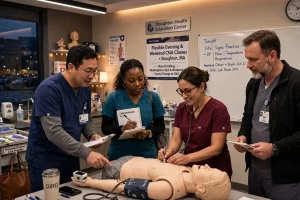

Alt Text: Side-by-side comparison of a MAP certified worker in a community group home and an LPN in a clinical hospital setting in Massachusetts.
One of the most common questions we hear from students exploring direct care careers in Massachusetts is whether they need a nursing license to administer medications. The short answer is no, but the longer answer has important limits that every candidate should understand before picking a training path. MAP certification and LPN licensure are two very different credentials with different scopes of practice, different training lengths, and different career ceilings. This guide walks through exactly how MAP compares to becoming a Licensed Practical Nurse, when each credential is the right fit, and how to decide which path belongs in your next step.
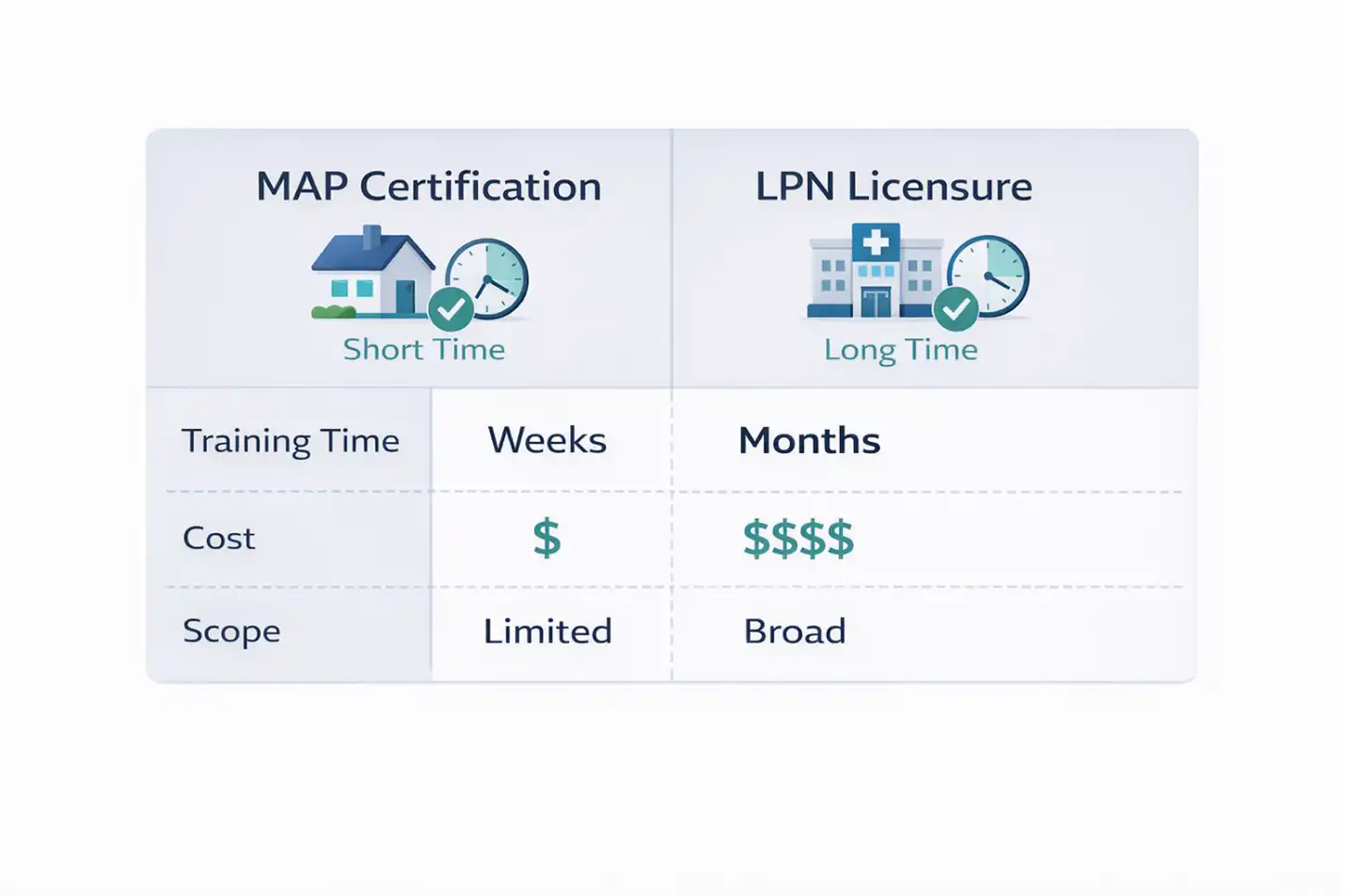
Alt Text: Infographic comparing MAP certification and LPN licensure in Massachusetts based on training time, cost, and work environment.
Quick answer: Yes, you can legally administer medications in Massachusetts without a nursing license, but only in specific DDS, DMH, DCF, and MassAbility community settings, and only with MAP certification. LPN licensure is required for medication administration in hospitals, skilled nursing facilities, and most clinical settings.
The Short Answer for Most Students
If your goal is to work in a group home, day program, or community residence, MAP certification is the faster, less expensive path to administering medications. If your goal is to work in a hospital, skilled nursing facility, or physician’s office, you need LPN licensure at minimum. MAP does not substitute for a nursing license in clinical settings, and a nursing license does not automatically cover you for MAP-regulated medication administration in DDS-funded community programs, which sometimes require separate MAP certification even for licensed nurses.
If you are still building your credential foundation, start with our MAP certification requirements in Massachusetts guide to check eligibility before comparing paths.
What MAP Certification Actually Covers
The Medication Administration Program is a Massachusetts-specific certification governed by the Department of Public Health (DPH) and administered through D&S Diversified Technologies. It authorizes direct care workers to administer medications to residents in DDS, DMH, DCF, and MassAbility community programs, including group homes, adult day programs, and community residences.
MAP is scope-limited by design. Certified staff administer medications that have been prescribed by a healthcare provider, documented by a nurse, and packaged for safe community administration. MAP staff do not perform clinical assessments, prescribe medications, adjust doses, administer injections that require nursing judgment, or provide skilled nursing care. The certification is focused specifically on safe, accurate, and documented medication handling under established protocols.
What LPN Licensure Actually Covers
A Licensed Practical Nurse holds a state nursing license issued by the Massachusetts Board of Registration in Nursing. LPN training typically involves a 12 to 18 month program at a community college or vocational school, followed by passing the NCLEX-PN exam. The scope of practice is significantly broader than MAP.
LPNs perform patient assessments, administer injections and IV medications under supervision, start and monitor intravenous therapy in approved settings, perform wound care, collect specimens, insert and remove catheters, monitor vital signs clinically, and assist physicians and RNs during procedures. LPNs work in hospitals, skilled nursing facilities, physician offices, home health agencies, rehabilitation centers, and other clinical environments that are generally outside the scope of MAP-regulated settings.
MAP vs LPN at a Glance
Here is the cleanest comparison across the factors students weigh most often before choosing a path.
| Factor | MAP Certification | LPN Licensure |
| Credential Type | Certification under DPH regulations | State nursing license |
| Training Length | 16+ classroom hours plus practicum | 12 to 18 months full-time |
| Exam | D&S 3-component MAP test | NCLEX-PN national licensure exam |
| Typical Cost | Hundreds of dollars | Thousands to tens of thousands |
| Scope of Practice | Medication administration in community settings | Full clinical nursing within LPN scope |
| Work Settings | Group homes, day programs, community residences | Hospitals, SNFs, clinics, home health |
| Can Give Injections? | Limited to specific protocols | Yes, within scope |
| Typical Salary Range | Hourly boost over CNA or HHA rates | Significantly higher base salary |
When MAP Is the Right Choice
MAP is the right fit when several of the following apply to your situation. You want to work specifically in DDS-funded group homes, day programs, or community residences. You want a faster, more affordable path to administering medications without committing to a full nursing program. You already hold a CNA or HHA credential and want to stack an additional certification quickly. You enjoy direct care work and the close relationships it builds with residents over time. You want credential-based income growth without the time commitment of nursing school.
Typical MAP Career Profile
A common pattern looks like this. A CNA working in a nursing home decides they want more predictable hours and deeper relationships with residents. They take MAP training, find a position in a DDS-funded group home, and move from hourly shift work to steady employment with a smaller number of residents they see consistently. Pay per hour increases, commute patterns become more predictable, and the work itself feels more personal.
To see how MAP specifically changes your earning potential, read our breakdown of how CNAs can earn $25 to $40 per hour with flexible shifts in Massachusetts. For a full cost breakdown of MAP training, see how much does MAP certification cost in Massachusetts.
When LPN Is the Right Choice
LPN is the right fit when your career goals point toward clinical settings. You want to work in a hospital, skilled nursing facility, or physician office. You want to perform the full range of LPN clinical duties, not only medication administration. You plan to eventually bridge to an RN or BSN program, and LPN is the first step. You want broader scope of practice and the professional autonomy that comes with a nursing license. You are willing to invest 12 to 18 months of training plus exam preparation for long-term career returns.
Typical LPN Career Profile
A common pattern for LPN candidates looks like this. A CNA with a few years of experience realizes they want to move beyond basic patient care into clinical roles. They enroll in an LPN program at a community college, complete 12 to 18 months of training, pass the NCLEX-PN, and take a position on a hospital medical-surgical floor or in a skilled nursing facility. From there, many continue on to RN bridge programs while working.
Can You Hold Both MAP and LPN?
Yes, and some healthcare workers do. An LPN working in a DDS-funded community residence may also carry MAP certification specifically because the facility operates under MAP regulations that require certified medication administrators regardless of nursing license. This situation is less common but valid, and it demonstrates that the two credentials serve different regulatory purposes even when held by the same individual.
For most students, however, the decision is one or the other based on career direction. MAP is the right pick for community-based direct care. LPN is the right pick for clinical nursing work.
How to Decide Between MAP and LPN
The decision usually comes down to four questions.
✓ Where do you want to work? Community-based settings point to MAP. Clinical settings point to LPN.
✓ How much time can you invest? A few months of training suggests MAP. A 12 to 18 month program suggests LPN.
✓ What is your budget? Hundreds of dollars fit MAP. Thousands to tens of thousands fit LPN.
✓ What is your long-term career direction? Stable direct care with relationship-driven work fits MAP. Clinical career growth with bridges to RN or BSN fits LPN.
Ready to Enroll in MAP Certification?
If MAP matches your career goals, our Stoughton campus runs DPH-aligned MAP training on flexible evening and weekend schedules. See current class dates and reserve your seat today.
Still confirming eligibility? Start with our MAP certification requirements guide to check your prerequisites. If you are considering the direct care path more broadly, review our how to become a CNA in Massachusetts guide first, since CNA or HHA is a common prerequisite for MAP.