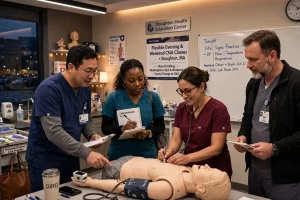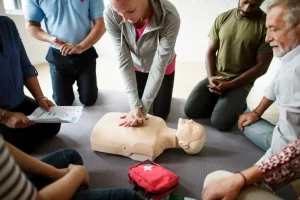

Alt Text: Students in a Massachusetts MAP class practicing medication administration at a simulated medication station with an instructor.
Signing up for a Medication Administration Program class is a real investment of time, energy, and focus. First-time students often walk in anxious because the stakes feel higher than a standard healthcare course. You are training to safely administer medications to residents who depend on your accuracy, and Massachusetts makes sure that training meets strict Department of Public Health standards. This guide walks through exactly what happens in a MAP class from the first day of enrollment to the moment you see your name added to the state MAP Registry, so you can arrive prepared rather than guessing.
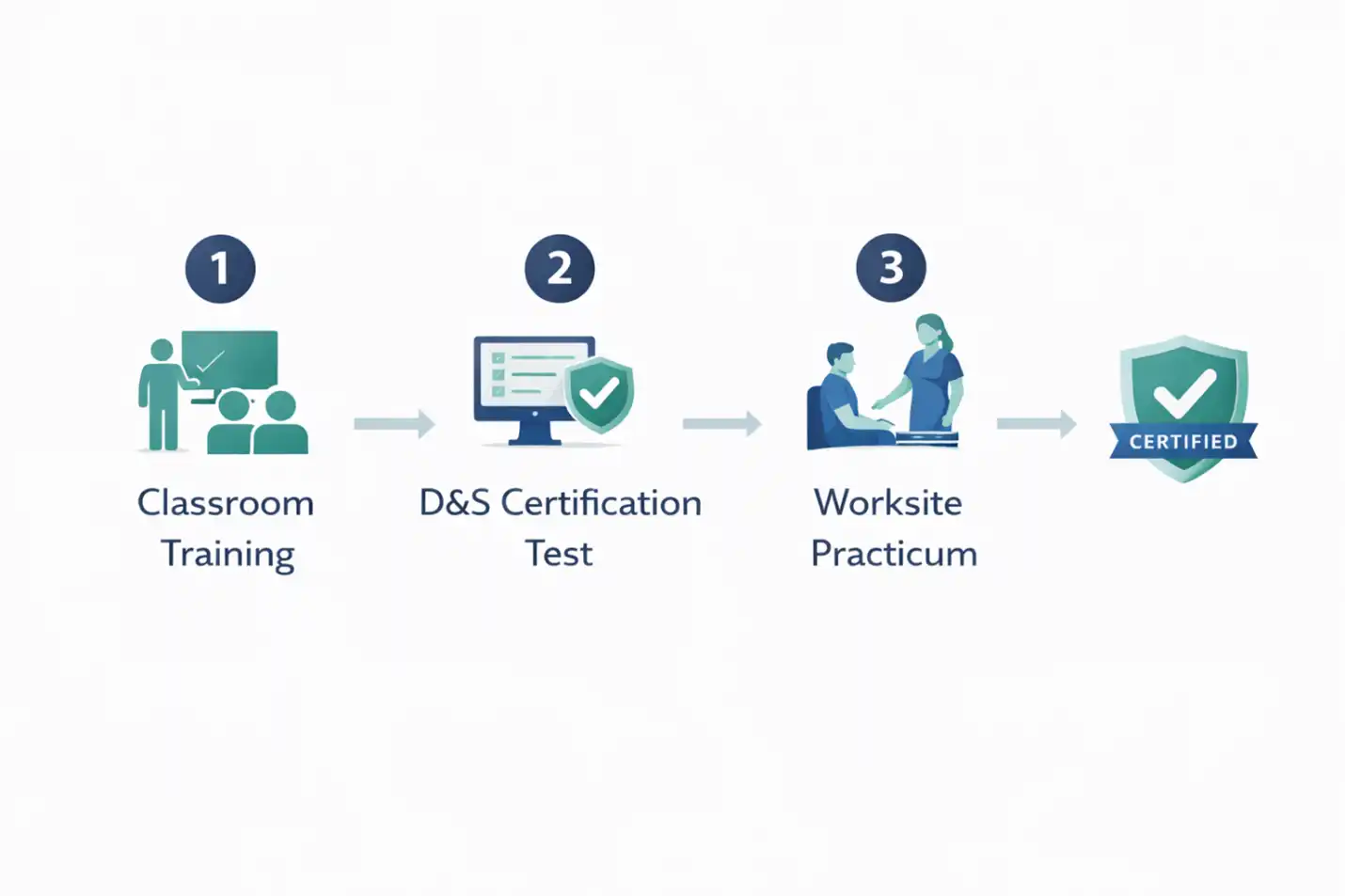
Alt Text: A 3-step roadmap showing the path to MAP certification: Classroom Training, D&S Testing, and Worksite Practicum.
Quick overview: A MAP class in Massachusetts includes at least 16 classroom hours covering DPH regulations, medication safety, transcription, and documentation. After classroom training you must pass a three-component test through D&S Diversified Technologies plus complete worksite practicum hours under nurse supervision before certification is finalized.
What Happens Before Class Starts
Once you enroll in an approved MAP training program, the pre-class work begins. You complete a prerequisite verification step where the program confirms your CNA or HHA registry status, CPR or BLS card, CORI background check, and high school credential. This step usually takes a few business days. Programs that skip verification risk enrollment issues later in the certification process.
You receive pre-class study materials covering the DPH MAP Policy Manual overview, key terminology, medication classifications, and the five rights of medication administration. Most students review these materials over a few evenings before the first classroom session. Students who arrive with the materials already reviewed move through the classroom portion faster because the vocabulary is already familiar.
For the complete enrollment checklist, see our MAP certification requirements in Massachusetts guide.
What to Bring and Wear to Class
Dress comfortably in clothing that works for a classroom and for supervised medication practice. Scrubs are common and work well, though regular professional clothing is also fine. Avoid restrictive fabrics, open-toed shoes, or heavy jewelry that interferes with hand hygiene during skills practice.
Bring a government-issued photo ID, any pre-class materials the program sent you, a notebook, several pens, a water bottle, and a basic calculator for medication math. All training equipment including sample medication orders, MAR forms, pill cutters, and practice pharmaceuticals are provided by the program. You do not need to bring any medical supplies yourself.
The Classroom Format
A full MAP training in Massachusetts runs a minimum of 16 classroom hours spread across multiple sessions. At our Stoughton campus, classes typically meet on evenings or weekends across two to three weeks to accommodate working adults. The classroom time alternates between instructor-led lessons, small group practice, medication math exercises, and transcription drills.
Our Stoughton classroom is set up to mimic a real group home medication station, providing the most realistic environment for our students from the Greater Boston area.
Instructors rarely lecture for more than 15 minutes at a stretch because MAP competency lives in repetition. Students practice reading medication orders, transcribing them to the MAR, identifying the five rights, and documenting administration across multiple realistic scenarios before moving on to the next topic.
MAP Curriculum Breakdown: What You Will Learn
The MAP curriculum follows the Massachusetts DPH MAP Policy Manual structure. Here are the core topics covered across the 16 classroom hours.
Five Rights of Medication Administration
The foundation of MAP practice. Right resident, right medication, right dose, right route, and right time. You drill this framework until recall becomes automatic because every documented medication pass references these five checkpoints.
Medication Classifications and Common Medications
Overview of the medication classes most commonly administered in DDS, DMH, DCF, and MassAbility community settings. Includes antipsychotics, mood stabilizers, antiepileptics, cardiac medications, diabetes management, and pain medications. You learn the general purpose, common brand and generic names, and typical side effects for each class.
Medication Math and Dosage Calculations
Real medication math problems using actual dosages and prescribed schedules. You practice converting between units, calculating partial doses when a resident needs half a tablet, and verifying dosages against prescribed orders. Students without recent math practice often find this section challenging at first, which is why instructors build in extensive drill time.
Transcription and the MAR
Transcription is often the most technically demanding component of MAP training. You learn to read a Health Care Provider medication order, transcribe it accurately onto the Medication Administration Record (MAR), and confirm that the transcription matches the original order exactly. Errors at the transcription stage cascade into real-world medication errors, which is why D&S tests this skill as its own component.
PRN Medications and Clinical Judgment
PRN medications are administered as needed rather than on a fixed schedule. MAP candidates learn the specific rules that govern PRN administration, including required pre-administration checks, documentation, outcome follow-up, and the limits of PRN decision-making under DPH regulations.
Storage, Disposal, and Documentation
DPH has specific rules for medication storage, counting, locked cabinet standards, disposal of expired or refused medications, and documentation. You learn the paperwork, the counting procedures for countable medications, and the reporting rules for medication discrepancies.
Error Recognition and Reporting
Despite careful practice, medication errors do occur in direct care settings. MAP training covers how to recognize an error, how to respond when one happens, and how to document and report it under DPH and facility-specific protocols.
Pretests Throughout Training
Throughout the classroom portion, you complete pretest assessments that simulate the format of the D&S Certification Test. Pretests cover knowledge, transcription, and medication administration demonstration. Your trainer uses pretest scores to identify weak areas and provide targeted practice before you sit for the official D&S test.
You must pass all pretest components before becoming eligible to register for the D&S test. This checkpoint exists to prevent students from paying for an official test they are not yet ready to pass.
The Official D&S MAP Certification Test
Once you complete training and pass the pretests, you register for the D&S Diversified Technologies MAP Certification Test through TestMaster Universe at ma.tmuniverse.com. The official test has three components, and all three must be passed to earn certification.
| Component | What It Tests | Format |
| Knowledge Test | Medication classifications, DPH regulations, safety protocols, documentation standards | Computer-based multiple choice |
| Transcription Test | Reading a Health Care Provider order and transcribing it accurately onto the MAR | Hands-on skills assessment |
| Administration Demonstration | Performing a full medication pass under certified tester observation | One-on-one skills test, 10 minutes |
You have six months from the end of MAP Training to complete all three components. You have three funded attempts per component if you are sponsored by DDS, DMH, DCF, or MassAbility. Non-sponsored candidates pay for each retest themselves.
The Worksite Practicum Requirement
Passing the D&S test is not the final step. You still must complete worksite practicum hours at your employer before your MAP certification is finalized. During practicum, you perform actual medication passes at a DPH-registered MAP site under direct supervision by a registered nurse or approved MAP trainer.
The practicum serves as the bridge between classroom knowledge and real-world practice. Your supervising nurse observes your technique, confirms your documentation, and signs off on your competency. Once the practicum is complete, your name is added to the Massachusetts MAP Registry and you are authorized to administer medications independently.
What Happens If You Struggle
Struggling with specific MAP skills is common. Medication math trips up students who have not done arithmetic in years. Transcription feels overwhelming to students who have never read provider orders before. Skills check-offs can feel high-pressure in the moment.
Instructors at our Stoughton campus are trained to coach students through difficulty rather than simply pass or fail them. If you miss a D&S test component, you have up to three attempts before remedial training is required. Small class sizes and one-on-one practice time help students fix weak areas before retesting rather than keeping their fingers crossed.
Tips for a Smoother MAP Class
✓ Review Pre-Class Materials. Arriving familiar with MAP terminology lets you focus classroom time on technique instead of vocabulary.
✓ Practice Medication Math Early. Work through basic conversions and dosage problems before class starts. The rust comes off fast with a little practice.
✓ Bring a Calculator. Mental math under test pressure causes errors. Use a basic calculator for drills during class.
✓ Ask Questions in the Moment. Silent confusion leads to failed skills checks. Instructors would rather stop and re-explain than watch a student guess.
Ready to Enroll in MAP Class?
Our Stoughton campus runs MAP classes on flexible evening and weekend schedules designed for working CNAs, HHAs, and direct care professionals. Small class sizes, DPH-aligned curriculum, and one-on-one instructor support. Reserve your seat in the next MAP class today.
Still confirming eligibility? Review our MAP certification requirements guide before enrolling. Curious about tuition? See the full MAP certification cost breakdown for Massachusetts.