Many employers assume a first aid kit on the wall is enough. Often it is not. OSHA has specific expectations for trained responders, CPR and supplies, and getting it wrong can mean fines and an unprepared team when an emergency happens.
A note first: this is general guidance, not legal or compliance advice. Requirements depend on your workplace and hazards. Confirm your obligations with OSHA resources or a compliance professional.
The Core Rule
The main standard is 29 CFR 1910.151, and it applies to general industry employers of any size. In plain terms: if there is no infirmary, clinic or hospital in near proximity to your workplace, you must have a person or persons adequately trained to render first aid, and adequate first aid supplies must be readily available.
What Near Proximity Means
OSHA has long interpreted near proximity as emergency care available within about three to four minutes where serious injury is possible, such as falls, electrocution or amputation. If EMS cannot reliably reach you that fast, you need trained responders on site.
What OSHA Expects
| Requirement | What It Means for You |
| Trained first aid responders | If a medical facility is not in near proximity, designated staff must be trained |
| CPR training | Several OSHA standards require CPR-trained rescuers |
| Adequate supplies | First aid supplies readily available and suited to your hazards |
| AED consideration | OSHA encourages AED programs, and some states require an AED |
| Assess your hazards | Tailor training and supplies to your specific risks |
CPR and AED, Not Just First Aid
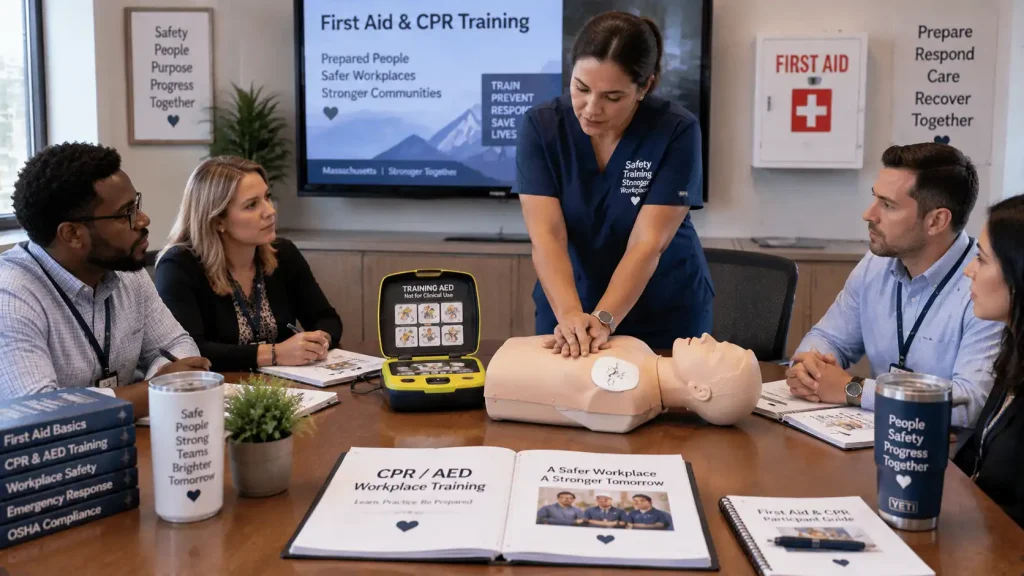
Sudden cardiac arrest can strike at any workplace, and CPR with an AED in the first minutes is what saves lives. Training your team in CPR and First Aid together covers both, and our AED guide explains how a defibrillator is used.
How Often to Retrain
Certifications expire, commonly every two years, and an expired card is the same as no card. See how long CPR certification lasts to plan renewals.
Frequently Asked Questions
Does OSHA require a trained first aid responder everywhere?
If there is no medical facility in near proximity, yes, for employers of any size.
What does near proximity mean?
OSHA has long interpreted it as care within about three to four minutes where serious injury is possible.
Does OSHA require CPR training?
Several OSHA standards require CPR-trained rescuers, and OSHA encourages AED programs.
Can you train our staff on site?
Yes. Group CPR and First Aid training can be delivered at your workplace so staff do not travel.
Workplace CPR and First Aid Training in Massachusetts
One Health and Beyond delivers group CPR and First Aid certification for businesses across Massachusetts, on site or at our Stoughton center. Contact us to train your team.