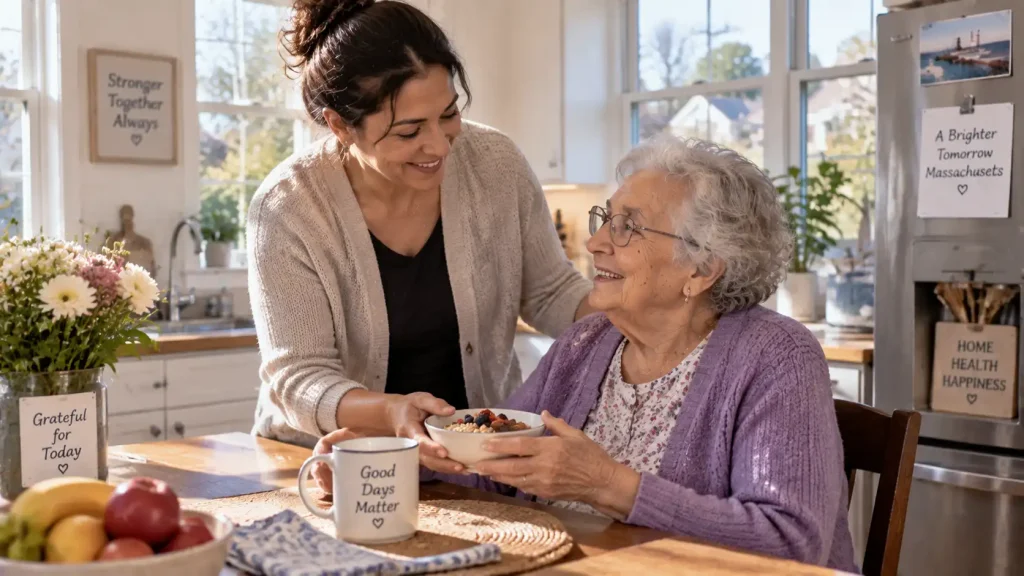
If you are already caring for a parent, a grandparent or a relative, you may be able to get paid for it in Massachusetts. Two state programs fund family caregiving, and a lot of families never apply simply because they do not know the programs exist. This guide explains both, who qualifies, and where to start.
One thing to know up front: the person you care for usually needs to have MassHealth, the state Medicaid program. That is the door most of this runs through.
The Two Main Ways to Get Paid
Massachusetts has two well-used programs that pay a family member to provide care. They fit very different situations, so start by figuring out which one matches your day to day.
| Personal Care Attendant (PCA) | Adult Foster Care (AFC) | |
| Best for | Part-time, come-and-go help with daily tasks | A live-in caregiver providing daily care |
| How it works | The member hires and directs their own attendants, who are paid an hourly wage | A relative provides daily care in a shared home and receives a tax-free monthly stipend |
| Living arrangement | Caregiver does not have to live with the member | Caregiver and member must live together |
| Oversight | Managed by the member with a Personal Care Management agency | An agency provides nurse oversight and case management |
| Care recipient must | Have MassHealth and need physical help with daily activities | Be 16 or older, have MassHealth, and need daily help with activities of daily living |
| Waitlist | An entitlement, so no waitlist for members who qualify | Can vary by agency, so call early |
Who Can Be the Paid Caregiver
This is where families get tripped up, so read it carefully.
- An adult child, sibling, grandchild, niece or nephew can usually be the paid caregiver
- Friends and neighbors can qualify too, especially under the PCA program
- A spouse generally cannot be the paid caregiver under either program, and a parent of a minor cannot be paid to care for that child. This is a federal Medicaid rule, not a state choice
- You do not need a license, a certificate or special schooling to be a PCA or AFC caregiver
Important: program rules change, and eligibility depends on your exact situation. Always confirm the current rules with MassHealth or the agency before you count on being paid. Treat this guide as a starting map, not the final word.
Who Qualifies for Care
The programs are built around the person receiving care, not the caregiver. In general the care recipient needs to:
- Be enrolled in MassHealth, usually MassHealth Standard or CommonHealth
- Have a lasting disability or condition that requires physical help
- Need help with everyday activities such as bathing, dressing, eating, toileting or moving around
- Pass a functional assessment that determines how much help is approved
How the PCA Program Works
The PCA program is participant-directed, which means the person receiving care is treated as the employer. They choose their attendant, which can be a qualifying family member, and they direct the work. A Personal Care Management agency helps with the assessment and paperwork, and a fiscal intermediary handles payroll.
Because it is an entitlement, members who qualify are not put on a waitlist. The number of paid hours is based on the assessment and what MassHealth approves.
How Adult Foster Care Works
Adult Foster Care fits a live-together situation. A relative or approved caregiver lives with the member and provides daily care, and receives a tax-free monthly stipend rather than an hourly wage. An agency provides nursing oversight and checks in regularly. There is a version called Group Adult Foster Care for members in a congregate setting such as assisted living.
AFC works well for the family member who has already moved in, or is about to, and is providing round-the-clock support.
Support If You Cannot Be Paid
If you are a spouse, or the person you care for does not have MassHealth, you may not be able to get paid through these two programs. You are not out of options. The Family Caregiver Support Program, run through your local Aging Services Access Point, offers respite so you can rest, plus counseling, training and referrals. It does not require MassHealth. Working caregivers can also use Massachusetts Paid Family and Medical Leave for time off.
How to Start
| Step | What to Do |
| 1 | Check whether the person you care for has MassHealth, or start a MassHealth application if they do not |
| 2 | Decide which fits your situation: part-time help points to PCA, living together points to AFC |
| 3 | Contact a Personal Care Management agency for PCA, or an Adult Foster Care agency for AFC, to begin the assessment |
| 4 | Complete the functional assessment that determines approved care |
| 5 | Finish caregiver onboarding and any required orientation, then begin providing care |
Approval takes time, often several weeks from assessment to first payment, so start early rather than waiting until you are worn out.
Turning Caregiving Into a Career
Many people who start by caring for a relative find they are good at it and want to make it a career. If that sounds like you, formal training opens up agency jobs, better pay and more clients. Our guide on how to become a home health aide in Massachusetts shows the path, and our Home Health Aide training in Stoughton is where a lot of family caregivers start.
Adding MAP certification later lets you administer medications in community programs, which raises pay, and a CPR and First Aid card is expected by almost every agency.
Frequently Asked Questions
Can I get paid to take care of my parent in Massachusetts?
Often yes, through the MassHealth PCA program or Adult Foster Care, if your parent has MassHealth and needs help with daily activities. An adult child can usually be the paid caregiver.
Can I be paid to care for my spouse?
Generally no. Under both the PCA program and Adult Foster Care, a spouse cannot be the paid caregiver. This is a federal Medicaid rule. Another qualifying relative may be able to serve instead.
Do I need a certificate to be a paid family caregiver?
No license or certificate is required to be a PCA or AFC caregiver. Formal training is optional, but it helps if you want to turn caregiving into an agency job.
Does the person I care for need MassHealth?
For the PCA program and Adult Foster Care, yes. Veterans have separate VA pathways, and Paid Family and Medical Leave is tied to employment rather than MassHealth.
How long does it take to get approved?
It varies, but plan on several weeks from the assessment to your first payment. Starting early is the best move.
Thinking About a Career in Care
If caregiving is becoming your calling, One Health and Beyond in Stoughton trains home health aides and medication-certified staff, serving Brockton, Canton, Randolph, Sharon, Easton and Quincy. Contact us to learn about the next class.