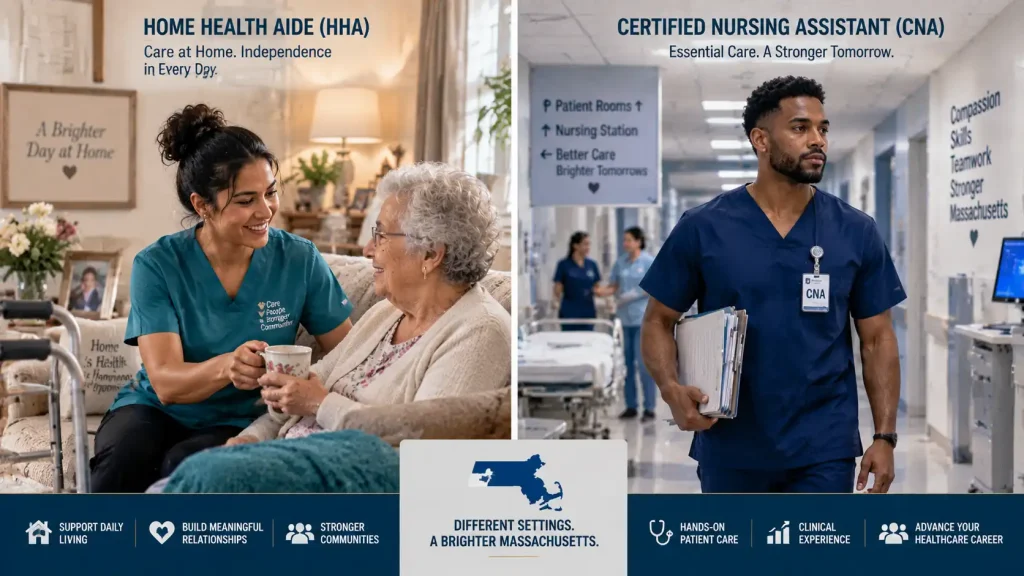
If you want to start a healthcare career in Massachusetts but do not want years of school, two names come up first: home health aide and certified nursing assistant. They sound similar, and people use them as if they are the same thing. They are not. The training is different, the settings are different, and the right choice depends on where you want to work.
This guide compares them plainly so you can pick with confidence.
The Short Answer
An HHA cares for clients in their own homes and can usually start faster. A CNA works mostly in facilities like nursing homes and hospitals, trains a bit longer, and takes a state competency exam to get on the Nurse Aide Registry. If you like the idea of one-on-one care in a home, lean HHA. If you want facility work and a state credential, lean CNA.
Side by Side Comparison
| What to Compare | Home Health Aide (HHA) | Certified Nursing Assistant (CNA) |
| Where you work | Clients homes, through home care and hospice agencies | Nursing homes, hospitals, rehab centers and long-term care facilities |
| Type of care | Personal care and daily living support under a care plan | Hands-on clinical care in a facility, often for many patients per shift |
| Training | At least 75 hours built on the federal standard, with supervised practical hours | At least 75 hours of state-approved training, including at least 16 hours of supervised clinical time before resident contact |
| How you qualify | Complete training and pass a competency evaluation observed by a registered nurse | Complete an approved program and pass the state Nurse Aide Competency Evaluation |
| Credential | Certificate of training and competency, tracked by your employer or program | Listed on the Massachusetts Nurse Aide Registry |
| Pace to first job | Often faster, since scheduling and hiring can move quickly | Slightly longer because of the separate state exam step |
| Best if you like | Building a relationship with one client at a time | A busy team setting with clinical variety |
Training and Time
Both start around the same length, roughly 75 hours, but the path differs. HHA training ends with a competency evaluation that your program usually arranges. CNA training ends with a separate state competency exam, and you are not certified until you pass it and appear on the Nurse Aide Registry.
That extra state exam is the main reason a CNA can take a little longer from first class to first paycheck. Neither path requires a college degree.
Where the Jobs Are
HHAs work where the client lives. That means home care agencies, visiting nurse associations, hospice and private-duty work. The setting is quiet and personal, usually one client at a time.
CNAs work where the patients are gathered. That means nursing homes, hospitals, rehab and long-term care, where you move between several patients across a shift. If you want to be inside a clinical team, that is the CNA world.
Pay
Pay for both depends on the employer, the shift and the setting, and the two ranges overlap more than people expect. Facility roles sometimes pay differently from home care, but shift differentials, overtime and specialized clients move the number in both directions.
The bigger pay lever is not choosing one over the other. It is stacking a credential on top. For direct care work, MAP certification lets you administer medications in DDS, DMH, DCF and MassAbility community programs, which often unlocks higher hourly rates. A current CPR and First Aid card is expected almost everywhere.
Can You Do Both, or Switch Later
Yes. Many people start as an HHA, get comfortable in the field, then add credentials as they go. Completing a state nurse aide program is even one of the recognized ways to qualify as an aide. You are not locking a door by starting with home care. See whether a CNA can work as a home health aide for how the two overlap.
Which One Should You Choose
Choose HHA if you want to start sooner, prefer one-on-one care, and like the idea of working in a home rather than a facility.
Choose CNA if you want facility experience, a state registry credential, and a busy clinical team around you.
If you are leaning toward home care, our Home Health Aide training in Stoughton walks you from first class to your competency evaluation, and our full guide on how to become a home health aide in Massachusetts lays out every step.
Frequently Asked Questions
Is an HHA the same as a CNA?
No. An HHA provides personal care in a client home under a care plan, while a CNA provides hands-on care in a facility and is listed on the state Nurse Aide Registry after passing a state exam.
Which is faster to start, HHA or CNA?
HHA is often faster because the competency evaluation is usually arranged through the training program, while CNA requires a separate state exam before you can work.
Does an HHA make less than a CNA?
Not necessarily. Pay for both depends on the employer, shift and setting, and the ranges overlap. Adding MAP certification tends to raise pay more than choosing one title over the other.
Can I become a CNA after working as an HHA?
Yes. Many people start in home care and add credentials later. The two paths overlap, and experience helps.
Do both need CPR certification?
Most employers in both fields expect a current CPR and First Aid card. It is a short class and worth having before you apply.
Start Your Home Care Career in Stoughton, MA
One Health and Beyond trains home health aides in Stoughton, serving Brockton, Canton, Randolph, Sharon, Easton and Quincy. See our Home Health Aide program or contact us to talk through the right start for you.