Home care is one of the fastest ways into healthcare work in Massachusetts. There is no degree to finish and no years of school to pay for. What you need is the right training, a competency evaluation, and an agency willing to put you on a schedule. This guide walks through each step in order.
What a Home Health Aide Does
A home health aide, usually called an HHA, supports people in their own homes so they can stay there instead of moving into a facility. The work is personal care and daily living support: bathing, dressing, grooming, help getting in and out of bed, light meal preparation, reminders, and watching for changes in a client condition.
HHAs work under a care plan and are supervised by a registered nurse. You are the person who sees the client most often, so noticing that someone is eating less or seems confused today is a real part of the job.
If you are still comparing roles, read the difference between an HHA and a PCA and what home health aides are not allowed to do before you choose a program.
Step by Step: Becoming an HHA in Massachusetts
Massachusetts does not run a separate state training rule for home health aides. Agencies that bill Medicare follow the federal standard, and that standard is what most Massachusetts programs are built around.
| Step | What You Do | Details |
| 1 | Check that you meet the basics | Be old enough to work for the agency you are applying to, able to read and follow a care plan in English, and physically able to assist with transfers and personal care |
| 2 | Choose a training program | Pick a program built on the federal standard, since that is what Medicare-certified agencies hire against. Ask how the clinical hours are arranged before you enroll |
| 3 | Complete at least 75 hours of training | The federal minimum is 75 hours, with at least 16 hours of classroom instruction completed before you begin at least 16 hours of supervised practical training |
| 4 | Pass the competency evaluation | A written portion and a hands-on skills portion, observed by a registered nurse. This is what confirms you can do the job, not just describe it |
| 5 | Clear a background check | Home care employers run a criminal background check. Some also require immunization records, a TB test and a drug screening |
| 6 | Get your paperwork in order | Keep your training certificate, your competency evaluation record and your identification together. Agencies ask for all of it at hiring |
| 7 | Apply to agencies | Visiting nurse associations, home health agencies, hospices and private-duty agencies hire entry-level aides year round |
| 8 | Keep your training current | Aides at Medicare-certified agencies need at least 12 hours of in-service training every 12 months, and an RN supervises your work on an ongoing basis |
Three ways to qualify. Federal rules allow an aide to qualify by completing a 75-hour training and competency evaluation program, by passing a competency evaluation on its own, or by completing a state nurse aide program and staying in good standing on the state registry. Most people entering home care take the first route, because the training is what prepares you for the evaluation.
What the 75 Hours Actually Cover
Programs differ in how they schedule the hours, but the content is fairly consistent because the competency areas are set federally.
Classroom topics
- Communication with clients, families and your supervisor
- Infection control and hand hygiene
- Reading and following the care plan
- Observing, reporting and documenting changes
- Nutrition, hydration and meal preparation
- Safety in the home and emergency response
- Client rights, privacy and dignity
Hands-on skills
- Bathing, grooming, oral care and skin care
- Dressing and toileting assistance
- Safe transfers and positioning
- Assisting with walking and mobility devices
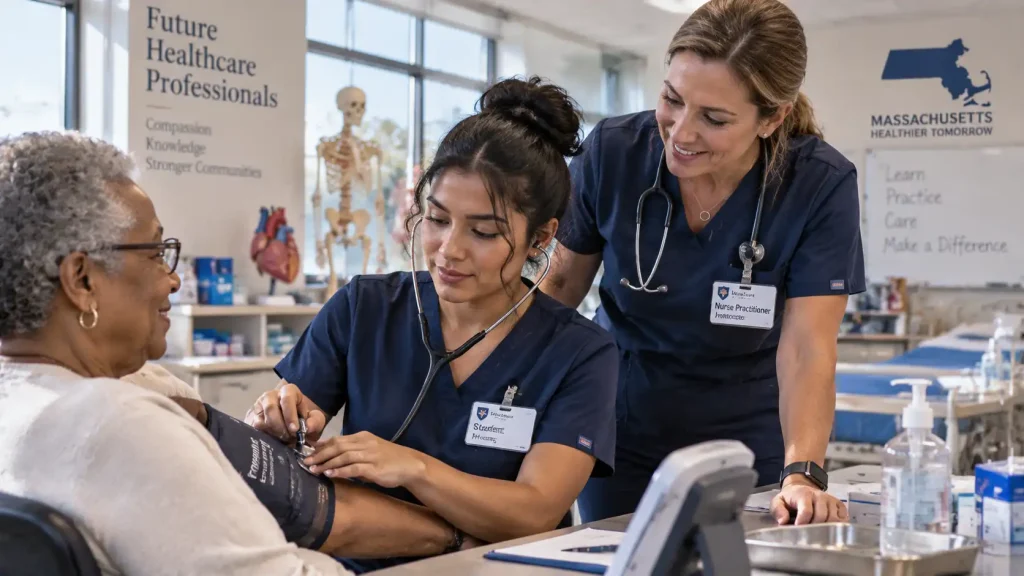
- Taking and recording vital signs
- Feeding assistance and special diets
- Range of motion and simple exercises
Our Home Health Aide training in Stoughton is built around these areas, and this guide explains what a certification program looks like day to day.
How Long It Takes
The training itself is short. Many students finish in a few weeks, depending on whether they attend full days, evenings or weekends. Add a little time for scheduling your competency evaluation and clearing your background check, and most people move from first class to first shift inside a couple of months.
That timeline is the main reason people choose home care over longer programs. You are earning while others are still in a classroom. Here is what the first week on the job feels like.
Where HHAs Work in Massachusetts
Most aides work for agencies rather than directly for families, at least at first. An agency handles scheduling, supervision and payroll, and gives you an RN to call when something changes with a client.
- Home health agencies and visiting nurse associations
- Hospice organizations
- Private-duty home care companies
- Assisted living residences and adult day programs
- State-funded home care programs through elder services agencies
Read more about where our graduates end up working and where home care jobs are heading in Massachusetts.
Pay and Growth
Pay depends on the agency, the shift and the setting, and aides who take on harder schedules or specialized clients usually earn more. Our guide on raising your pay as an HHA in Massachusetts covers what actually moves the number.
The credential that most often raises pay is not another aide certificate. It is MAP certification, which allows direct care staff to administer medications in DDS, DMH, DCF and MassAbility community programs. Many aides add it once they have some experience, and a lot of employers pay for it.
A current CPR and First Aid card is the other credential agencies ask about constantly. It is a one-day class and it removes an easy reason for an employer to pass on your application.
Mistakes That Slow People Down
- Enrolling in a program without asking how the supervised clinical hours are arranged, then discovering there is no placement
- Waiting to start the background check, which is often the slowest part of hiring
- Letting the training certificate and competency record sit in a pile instead of scanning them
- Applying to only one agency and waiting, instead of applying to several at once
- Assuming every employer has the same paperwork requirements, when immunization and testing rules vary
Frequently Asked Questions
How many hours of training do I need to become an HHA in Massachusetts?
The federal standard is at least 75 hours, including at least 16 hours of classroom instruction before at least 16 hours of supervised practical training. Massachusetts does not set a separate state training rule, so agencies that bill Medicare follow the federal standard.
Do I need to be a CNA first?
No. CNA and HHA are separate routes. Completing a state nurse aide program and staying in good standing on the registry is one of the ways to qualify as an aide, but it is not required. See whether a CNA can work as a home health aide.
Is there a state exam?
You complete a competency evaluation with a written portion and a skills portion, observed by a registered nurse. It is usually arranged through your training program rather than scheduled at a separate state test center.
Will I be listed on a registry?
Registry and record keeping practices vary by employer and program. Ask the agency you are applying to what documentation they need, and keep copies of everything from your training.
Do I need a driver license?
Not always, but it helps. Agencies assign clients across a service area, and aides who can drive usually get more hours and more choice of assignments.
Do I have to keep training after I am certified?
Yes. Aides at Medicare-certified agencies need at least 12 hours of in-service training every 12 months, and a registered nurse supervises your work on an ongoing basis.
Can I train while working another job?
Many students do. Ask about evening and weekend schedules when you compare programs. Contact us for our current class times.
Start Your HHA Training in Stoughton, MA
One Health and Beyond trains home health aides in Stoughton, serving students from Brockton, Canton, Randolph, Sharon, Easton and Quincy. See our Home Health Aide program or contact us for the next start date.