Important: this guide explains infant CPR so you can understand and remember the steps. It is not a substitute for a hands-on class. CPR is a physical skill, and you learn it best by practicing on a manikin with an instructor. Take a class before you need it, not during an emergency.
Infant CPR is different from adult CPR. Babies are smaller, their emergencies more often start with a breathing problem than a heart problem, and the hand technique is different. Knowing what to do in the first minute, before help arrives, is what makes the difference.
An infant means a baby under one year old. For a child from one year to puberty, see our note near the end. Adults follow different steps again, covered in our CPR and First Aid certification class.
Before You Start: Check the Scene and the Baby
- Make sure the area is safe for you and the baby
- Tap the bottom of the baby foot and call their name to check for a response
- Look for normal breathing. Gasping is not normal breathing
- If the baby is unresponsive and not breathing normally, you are going to start CPR
If you are alone and did not see the baby collapse, give about two minutes of CPR first, then call 911 and get an AED if one is nearby. If someone else is with you, send them to call 911 right away while you begin.
Infant CPR Step by Step
| Step | What to Do |
| 1 | Place the baby on a firm, flat surface on their back |
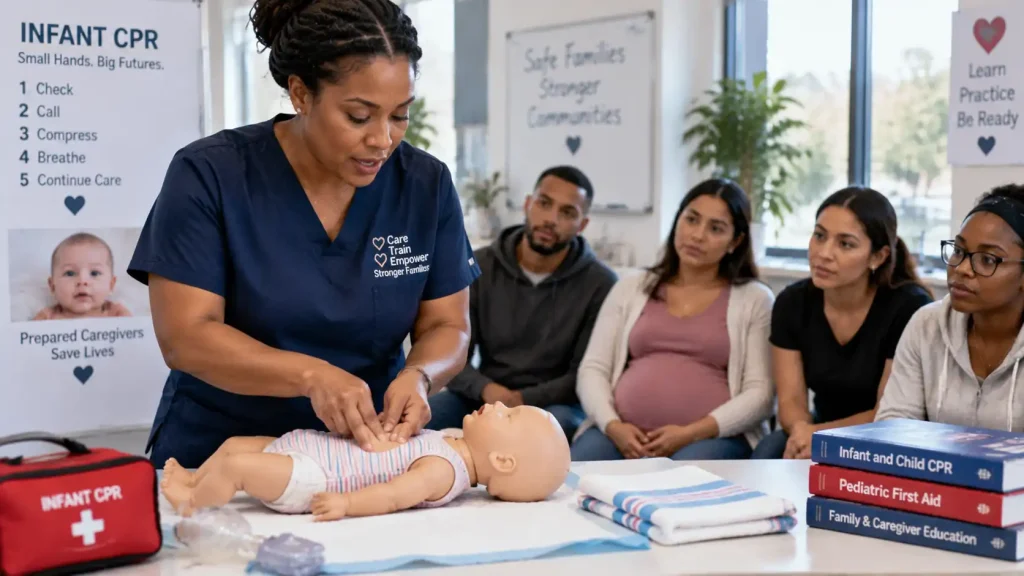
| 2 | Give 30 chest compressions in the center of the chest, just below the nipple line. Use two thumbs with your hands encircling the chest, or the heel of one hand. Push down about one and a half inches, at a rate of 100 to 120 compressions per minute, and let the chest come all the way back up between each push |
| 3 | Open the airway with a gentle head tilt and chin lift. Do not tilt too far, since a baby airway is small |
| 4 | Give 2 rescue breaths. Cover the baby nose and mouth with your mouth and give a gentle puff, just enough to see the chest rise. Do not blow hard |
| 5 | Continue cycles of 30 compressions and 2 breaths |
| 6 | Use an AED as soon as one arrives, using pediatric pads or settings if available |
| 7 | Keep going until the baby shows signs of life, help arrives and takes over, or you are too exhausted to continue |
If two trained rescuers are present, the compression to breath ratio changes to 15 compressions and 2 breaths, but a single rescuer uses 30 and 2.
The Numbers to Remember
| What | Infant (under 1 year) |
| Hand technique | Two thumbs encircling the chest, or the heel of one hand |
| Compression depth | About one and a half inches |
| Compression rate | 100 to 120 per minute |
| Single rescuer ratio | 30 compressions to 2 breaths |
| Two rescuer ratio | 15 compressions to 2 breaths |
| Rescue breath | A gentle puff, just enough to see the chest rise |
What changed recently: current guidelines favor the two thumbs encircling technique or the heel of one hand over the older two-finger method, because they reach a better compression depth. Guidance can be updated, so what you learn in a current class is always the most reliable source.
If the Baby Is Choking, Not in Cardiac Arrest
Choking is different from CPR. If a baby is coughing forcefully, let them cough, since coughing can clear the object. If the baby cannot cough, cry or breathe, act immediately:
- Give 5 back blows: hold the baby face down along your forearm, supporting the head, and strike between the shoulder blades with the heel of your hand
- Turn the baby over and give 5 chest thrusts in the center of the chest
- Repeat the cycle of 5 back blows and 5 chest thrusts until the object comes out or the baby becomes unresponsive
- If the baby becomes unresponsive, start CPR
Do not give abdominal thrusts to an infant. The Heimlich style abdominal thrust used for older children and adults is not recommended for babies, because it can cause injury. Our choking response guide covers all ages in more detail.
What About Children Over One Year
For a child from one year to puberty, the steps are similar, but you use the heel of one or both hands and push about two inches deep. For choking in a child, you use 5 back blows alternating with 5 abdominal thrusts, unlike an infant. A full class covers adult, child and infant technique together, which is why parents and childcare staff usually take the pediatric option.
Who Should Learn Infant CPR
- New and expecting parents
- Grandparents and family members who watch the baby
- Babysitters and nannies
- Daycare and preschool staff
- Anyone responsible for young children
If you care for children, the class to take is one that includes infant technique. Our CPR and First Aid certification in Stoughton offers an adult, child and infant option, and teens starting to babysit can begin with our babysitting and child safety course.
Frequently Asked Questions
How deep should infant chest compressions be?
About one and a half inches, at a rate of 100 to 120 compressions per minute, letting the chest come all the way back up between compressions.
What is the compression to breath ratio for infant CPR?
A single rescuer uses 30 compressions to 2 breaths. Two trained rescuers use 15 compressions to 2 breaths.
Should I do abdominal thrusts on a choking baby?
No. For an infant, use 5 back blows alternating with 5 chest thrusts. Abdominal thrusts are not recommended for babies.
Can I learn infant CPR online?
Reading the steps helps you understand and remember them, but CPR is a hands-on skill. Take a class where you practice on an infant manikin with an instructor.
When do I call 911 if I am alone?
If you did not see the baby collapse, give about two minutes of CPR first, then call 911 and get an AED. If you saw the collapse, call first, then start CPR.
Learn Infant CPR in Stoughton, MA
One Health and Beyond offers hands-on CPR and First Aid certification in Stoughton, including adult, child and infant technique, serving Brockton, Canton, Randolph, Sharon, Easton and Quincy. Contact us for the next class date.