
Choosing where to complete your home health aide certification shapes what your next year looks like. Train close to home in Stoughton and your commute stays short, your evenings stay yours, and the agencies hiring in Norfolk County already know the program you graduated from. Train an hour into Boston and you spend real money and hours on the drive before your first shift. This guide covers what HHA training in Stoughton actually involves, what Massachusetts requires, and what the local job market looks like when you finish.
What Training Local Actually Saves You
The practical case for local training is not just convenience. It is time, money, and energy you can spend on the course itself.
Commute. Getting to a Boston training center from Stoughton, Brockton, Randolph, Canton, Sharon, Easton, or Norwood is 45 minutes to over an hour each way in traffic, plus tolls or parking. Over a 4- to 6-week program that meets several days a week, the drive alone can eat 40 to 60 hours you would otherwise spend studying, working, or with family.
Cost. Gas, parking, and (for some) train fare adds up to hundreds of dollars over the course. That is money that could go toward your certification cost, exam fee, or the first month’s expenses while you start work.
Job market fit. Home care agencies hiring in Stoughton and the surrounding towns already know local training programs and often have working relationships with instructors. When your resume comes across their desk, they recognize the program and trust the training.
What Massachusetts Actually Requires for HHA Certification
This is where most generic “become an HHA” articles get thin. Here are the actual rules.
Massachusetts does not have its own separate HHA licensure. Instead, the state relies on the federal Medicare standard set in 42 CFR 484.80, which applies to any home health aide working for a Medicare-certified home health agency. That standard requires:
- At least 75 hours of training total.
- At least 16 hours of classroom instruction completed BEFORE you start supervised practical training.
- At least 16 hours of supervised practical (clinical) training as part of the total 75.
- A competency evaluation covering personal care, safety, infection control, communication, observation and reporting, and basic health procedures.
- 12 hours of annual in-service training every year once you are working, arranged by your employer.
Massachusetts has a few program pathways that fit around that federal standard:
- The standard 75-hour HHA program, which is what most Stoughton-area training programs run. Graduates receive a Home Health Aide certificate of completion.
- The CNA route: a certified nursing assistant on the Massachusetts Nurse Aide Registry can qualify to work as an HHA at a Medicare-certified agency without repeating HHA training, because CNA training meets the federal 75-hour minimum.
- PHCAST (Personal and Home Care Aide State Training) is a free MA program that trains people for homemaker and personal care aide roles funded through Aging Services Access Points. PHCAST alone does not meet the federal HHA standard and does not qualify you to work as an HHA at a Medicare-certified agency. If your goal is HHA certification, you want a 75-hour HHA program, not PHCAST.
The Home Care Aide Council administers an optional competency exam in Massachusetts that many local agencies value on your resume. It is not mandatory, but it signals that you passed an independent evaluation, and some employers prefer candidates who hold it.
What to Look for in a Stoughton HHA Program
Not every program is built the same. A few things separate strong local training from a weekend certificate mill.
Federal-compliant curriculum. The program must meet 42 CFR 484.80: at least 75 hours, with the classroom-before-clinical sequencing intact. Ask for the hour breakdown in writing before you enroll.
Real hands-on time. The 16 hours of supervised clinical practice matter. Programs that rush through it or substitute video demonstrations for real practice leave you unprepared for your first client’s home. When you evaluate a program, ask how many hours you will spend physically practicing transfers, bathing, vital signs, and safe body mechanics.
Instructors with direct-care backgrounds. Programs led by nurses or experienced HHAs who have worked in patient care share tips and clinical judgment you cannot get from a textbook-only instructor. Ask who teaches the program.
Schedule that fits your life. Working adults, parents, and second-career students need programs with evening or weekend options. A program that only runs 9-to-5 weekday classes excludes most people who need this certification to change careers.
Transparent all-in cost. Some programs advertise a low tuition then add fees for the study book, exam registration, background check, or clinical uniform. Ask for the total price you will pay before you sign.
Support through the competency evaluation. The best programs run practice competency evaluations so you walk into the real one already familiar with the format.
Our HHA program in Stoughton covers all of the above, with schedules built for working adults and small enough class sizes for real hands-on time.
Cost and What You Earn
HHA training programs in Massachusetts typically range from about $500 to $2,000 all in, depending on the provider and what is included. Local Stoughton-area programs tend to sit in the lower half of that range. Compared with CNA training (often over $1,000) or a nursing program, HHA is one of the fastest and most affordable ways to enter direct care in the state.
The math on your investment works out quickly. According to Bureau of Labor Statistics data, Massachusetts HHAs earn an average of roughly $38,000 to $40,000 per year, with hourly rates commonly in the $18 to $24 range depending on employer, shift, and complexity of the case. Even at the low end, most students earn back the cost of the program in one to two months of full-time work.
Where Stoughton-Area HHAs Actually Work
Once you are certified, the Stoughton area gives you a healthy job market to work in without a long commute.
Home care agencies. Southeastern Massachusetts is served by both national and regional agencies with active openings across Norfolk and Plymouth counties. Agencies place aides with private clients in Stoughton, Brockton, Randolph, Canton, Sharon, Easton, Norwood, Weymouth, and beyond.
Assisted living and long-term care. Facilities in the region hire HHAs and CNAs for direct care roles, often with steady schedules and benefits.
Private-hire clients. Families in the area coordinate direct hiring through agencies or through the MassHealth Personal Care Attendant program when the client qualifies. Agency-employed HHAs and MassHealth PCAs are different setups; the PCA vs HHA guide covers when each applies.
How Far HHA Takes You in Massachusetts
HHA is a starting credential in Massachusetts, and it stacks well with two others that meaningfully raise your pay.
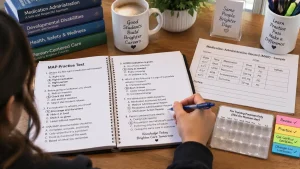
HHA plus MAP. The Massachusetts Medication Administration Program (MAP) certification authorizes non-nurses to administer medications in DDS, DMH, DCF, and MassAbility community programs (group homes, day programs). MAP-certified staff typically earn $2 to $3 more per hour and open a much wider set of higher-paying community roles. Many local direct care workers stack HHA + MAP together, since MAP does not require CNA first.
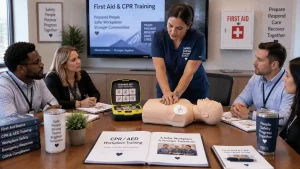
HHA plus CPR and First Aid. Most Massachusetts home care agencies expect a current CPR card on file. Adding ASHI CPR and First Aid certification makes you immediately more hireable and takes just one day.
HHA to CNA. If your longer-term plan is hospital or skilled nursing facility work, moving from HHA to CNA is a natural progression, and your HHA experience counts as direct care time on nursing school applications later.
Enrollment: What to Do Next
If you live in Stoughton or a neighboring town and you are ready to start, the process is short. Confirm you meet the enrollment basics (high school diploma or GED, CORI background check, negative TB test), enroll in a 75-hour HHA program, complete classroom hours before clinical, pass your competency evaluation, and start applying to local agencies. From enrollment to first shift, most students take about 6 to 10 weeks.
Frequently Asked Questions
Is HHA training the same as CNA training? No. Both meet the federal 75-hour standard, but CNA is a broader credential that lands you on the Massachusetts Nurse Aide Registry and permits work in more settings. HHA is faster and cheaper if home care is your target.
Do I need to be a CNA before working as an HHA in Massachusetts? No. A standalone 75-hour HHA program from an approved provider is enough to qualify for HHA work at a Medicare-certified agency. Some employers prefer CNA, but it is not a requirement.
Does PHCAST training make me an HHA? No. PHCAST is a free state training for homemaker and personal care aide roles funded through Aging Services Access Points. It does not meet the federal HHA standard for Medicare-certified agencies. If HHA is your goal, take a 75-hour HHA program.
How long does HHA training take? Most Stoughton-area programs run 4 to 6 weeks depending on schedule. Evening and weekend formats stretch that timeline slightly to accommodate working students.
How much does HHA training cost in Massachusetts? Programs typically range from $500 to $2,000. Local Stoughton programs tend to sit at the lower end.
Do I need to take the Home Care Aide Council exam? It is optional. It is not required to work as an HHA, but many local agencies value it and some prefer candidates who have passed it.
Can I work while I train? Yes, if you pick a program with evening or weekend schedules. Most Stoughton students continue current jobs during training.
What is the difference between HHA training in Stoughton and Boston? The curriculum is the same because the federal standard is the same. The differences are commute, cost, and how well your school is known to local hiring agencies.
Ready to Start
The path to a stable career in direct care does not require an hour of driving each way or a training bill you will spend six months paying off. A 75-hour program in Stoughton, taught by instructors who have worked in real patient care, prepares you for the same competency evaluation and the same job market as any Boston program, at a fraction of the time cost. See current enrollment dates and pricing for our Stoughton HHA program, or reach out with questions about scheduling around a current job.