
Certified Nursing Assistant is one of the most flexible entry points in healthcare. In Massachusetts, CNAs land in more settings than most people realize, and pay varies significantly depending on where you work, what shifts you take, and what credentials you stack alongside your CNA. If you are researching CNA work in the state, here is a straight-forward breakdown of the 10 most common workplaces, what each typically pays, and how to raise your ceiling once you are certified.
The Short Answer
Most Massachusetts CNAs work in nursing homes, hospitals, home health, or assisted living, but the state’s demand for direct care staff has pushed CNAs into DDS group homes, schools, hospice, correctional facilities, and other less obvious settings. Pay ranges roughly $18 to $30 per hour depending on setting and shift, with hospital, correctional, and DDS group home roles typically at the higher end. Stacking a MAP certification is the single biggest local pay lever available to any Massachusetts CNA who works in community programs.
1. Nursing Homes and Long-Term Care Facilities
The largest single employer of CNAs in Massachusetts. Residents live in the facility, so you build long-term relationships and see the same faces across shifts. Duties include bathing, dressing, feeding, mobility assistance, vital signs monitoring, and reporting changes to nurses.
Shifts run 8 hours typically, though 12-hour options exist. Weekend and holiday coverage is common. Pay generally runs $18 to $24 per hour in Norfolk, Plymouth, and Middlesex counties, with sign-on bonuses common at facilities facing staffing shortages.
Fits you if: you want steady hours, deep patient relationships, and predictable routines.
2. Hospitals
Boston-area hospitals and their regional systems hire CNAs across medical-surgical floors, telemetry units, and specialty departments. Pace is faster than long-term care, patient turnover is high, and CNAs support nurses with vital signs, transfers, transport, and daily living activities.
Hospital shifts are usually 12 hours, often with mandatory nights or weekends. Pay tends to run $20 to $28 per hour in the Boston metro, with shift differentials adding $2 to $6 per hour for nights and premium rates on weekends. Benefits packages (health insurance, tuition reimbursement, retirement) are typically stronger than in long-term care.
Fits you if: you want higher base pay, exposure to a wider range of conditions, and benefits that support future nursing school.
3. Emergency Departments
A subset of hospital work with its own rhythm. ED CNAs handle patient intake, help move patients between rooms and testing areas, assist with basic procedures, and support nurses during rapid changes in patient condition. Some Massachusetts hospitals hire dedicated ED CNAs; others rotate CNAs through from med-surg.
Pay is at the top of the hospital range because of the pace and skill required, typically $22 to $30 per hour with generous shift differentials.
Fits you if: you handle pressure well and want the fastest hospital environment.
4. Home Health Agencies
Home health CNAs provide one-on-one care in clients’ homes, either through an agency or directly for private clients. Duties include personal care, meal prep, light housekeeping tied to safety, health monitoring, and companionship. Massachusetts law requires agencies to pay for travel time between clients (not your commute to the first or from the last) plus mileage reimbursement, so factor that into your effective hourly rate.
Base pay commonly runs $19 to $26 per hour in Massachusetts, with private-hire arrangements sometimes higher. Per diem rates run $22 to $30. Scheduling is often the most flexible in the field.
Fits you if: you want variety, flexibility around childcare or school, or the option to work with fewer clients per day.
5. Assisted Living Communities
Assisted living residents are more independent than nursing home residents but still need daily support. CNAs help with medication reminders, mobility, meals, showers, and activities. The environment feels less clinical and more residential, and you build multi-year relationships with the same residents.
Pay runs $18 to $23 per hour. Schedules are more predictable than hospitals. Physical demands are lower than nursing home work because most residents are more mobile.
Fits you if: you want a stable location without the acuity of nursing home or hospital work.
6. DDS Group Homes and Community Programs
This is the Massachusetts-specific setting most people miss. Group homes serving adults with intellectual and developmental disabilities, funded through the Department of Developmental Services (DDS), hire heavily and pay a premium for CNAs who add MAP certification.
Duties combine direct care with support for daily life skills, community outings, and medication administration (for MAP-certified staff). Pay runs $19 to $27 per hour for CNAs, and MAP-certified staff typically earn $2 to $3 more per hour on top of that. Overnight positions in group homes often include awake-overnight premiums.
Fits you if: you want meaningful work with a stable resident population and are willing to add MAP certification for the pay boost.
7. Hospice and Palliative Care
Hospice CNAs care for people in the final weeks or months of life. Work is quieter, focused on comfort, dignity, and emotional support for both the patient and family. Duties include personal care, positioning, and observation.
Pay runs $20 to $26 per hour. Many hospice roles are part-time or per diem, which fits CNAs balancing other commitments.
Fits you if: end-of-life care matters to you and you have the emotional steadiness the work requires.
8. Rehabilitation Centers
Rehab facilities treat patients recovering from surgery, stroke, orthopedic procedures, and other conditions where a supervised recovery period is needed. CNAs support therapy schedules, help with mobility exercises prescribed by PT and OT, and handle daily care.
Pay runs $19 to $25 per hour. Rehab settings suit CNAs interested in eventually moving into physical or occupational therapy assistant roles.
9. School Health Aide Positions
Public and private schools in Massachusetts hire CNAs to support school nurses, manage first aid, help students with special needs, and maintain health records. Schedules follow the school calendar, which means summers, weekends, holidays, and school vacations off.
Pay runs $18 to $24 per hour. Total annual earnings tend to be lower because of the reduced work weeks, but the schedule fits parents extremely well.
Fits you if: you have school-age children or want summers off.
10. Correctional Facilities
State and county correctional facilities in Massachusetts hire CNAs for inmate healthcare. Pay is above the average CNA rate because of the security-required environment, running $21 to $30 per hour at facilities like Norfolk and Shirley. Benefits include state pension and structured advancement paths that most other settings do not match.
Fits you if: you value stability, government benefits, and structured environments.
What Raises Your Rate
Base pay is only part of the picture. Three levers move Massachusetts CNAs up the pay ladder.
Shift differentials. Night differentials commonly add $2 to $6 per hour. Weekend and holiday shifts add premiums. Many CNAs at the top of their setting’s range earn there because they take these shifts consistently.
Per diem work. Per diem (on-call) rates typically run $22 to $30 per hour because no benefits are attached. If you have benefits elsewhere (through a spouse, parent, or another job), per diem is often the highest hourly rate available.
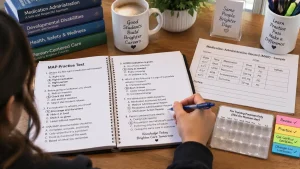
Credential stacking. In Massachusetts, adding MAP certification opens DDS group home and community program work, where MAP-certified CNAs earn $2 to $3 more per hour on top of base. MAP is the single highest-impact local credential you can add. A current CPR and First Aid card is a standard hiring expectation at most agencies.
Moving Into Massachusetts as an Out-of-State CNA
If you are already certified in another state, Massachusetts accepts CNA reciprocity for aides in good standing on their home state’s Nurse Aide Registry. You submit an application to the Massachusetts Nurse Aide Registry with proof of certification and employment history within the past 24 months. The Massachusetts CNA reciprocity process is straightforward for most eligible applicants and typically takes a few weeks.
What About HHA?
If you are researching CNA work but have not committed to a program yet, know that Massachusetts also has strong demand for Home Health Aides. HHA training runs shorter (2 to 6 weeks versus 4 to 8 for CNA), costs less, and qualifies you for home care and community roles. The HHA vs CNA comparison breaks down when each makes more sense, and stacking HHA with MAP is often the fastest local path to direct care work with strong pay.
How to Choose Where to Work
The right setting depends on what you want out of the job.
- Highest hourly pay → hospital, ED, or correctional
- Steadiest schedule → nursing home, assisted living, or school
- Most flexibility → home health or per diem
- Deepest relationships → nursing home, assisted living, or DDS group home
- Fastest path to nursing school → hospital or VNA
- Best fit for parents → school health aide or home health
- Best hourly boost in MA specifically → DDS group home with MAP added
Most Massachusetts CNAs try more than one setting during their first few years. What you learn about your own preferences in the first job usually shapes the second.
Frequently Asked Questions
Can a CNA work in more than one setting at the same time? Yes. Many Massachusetts CNAs combine a facility position with per diem home health or agency shifts to boost total income and gain variety.
Which Massachusetts CNA setting pays the most? Hospitals, ED work, and correctional facilities typically pay the highest base rates. DDS group home work with MAP certification often out-earns a straight nursing home CNA position.
Do all Massachusetts CNAs need CPR certification? Most employers require a current CPR card on file. Some cover it as part of onboarding; many expect you to arrive with one.
Can a Massachusetts CNA give medications? No, not without additional authorization. In DDS, DMH, DCF, and MassAbility community programs, MAP-certified staff can administer medications. In other settings, medication administration is a nursing task.
How do out-of-state CNAs work in Massachusetts? Through the Nurse Aide Registry reciprocity process, provided you are in good standing on your home state’s registry and have work history within 24 months.
Do Massachusetts CNAs get sign-on bonuses? Yes, especially at nursing homes and hospitals facing staffing shortages. Bonuses typically range from $1,000 to $5,000 depending on employer and commitment length.
Is home health CNA work worth it in Massachusetts? For many aides, yes. Base pay is competitive, travel time and mileage are required by state law to be reimbursed, and scheduling flexibility is unmatched.
Ready to Add Credentials
Whether you are already a Massachusetts CNA looking to raise your pay or entering direct care for the first time, the highest-impact local credential you can add is MAP certification, which authorizes medication administration in DDS, DMH, DCF, and MassAbility community programs. Pairing MAP with an HHA credential or a current CPR and First Aid card opens the widest set of Massachusetts direct care roles and moves you toward the top of the local pay range in every setting listed above.