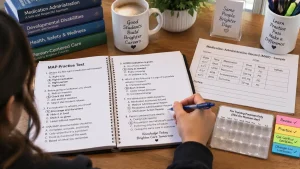

Before you enroll in a Medication Administration Program, it helps to know exactly what Massachusetts requires. MAP certification opens higher-paying direct care roles across DDS-funded group homes, day programs, and community residences, and the actual eligibility bar is simpler than a lot of people expect. The program runs under Massachusetts Department of Public Health regulations at 105 CMR 700.003 and the MAP Policy Manual, and testing is handled by D&S Diversified Technologies, the state-approved vendor. Here is what the state requires, what your employer may add on top, and how to confirm you qualify before you pay for a class.
What MAP Certification Is
The Medication Administration Program is a Massachusetts credential that authorizes direct care workers to give medications to residents in DDS, DMH, DCF, and MassAbility community programs, including group homes, adult day programs, and community residences. It is not a nursing license and does not replace one. It is scope-limited, governed by the MAP Policy Manual, and covers safe medication handling, the five rights of administration, documentation, PRN rules, and error response for non-clinical staff. Certification is only valid at MAP Registered sites operated or funded by those four agencies. If you want the wider picture of what the credential covers, see the MAP certification landing page, and if you are still deciding between MAP and nursing, the MAP vs LPN comparison lays out the difference.
What the State Actually Requires
The state eligibility bar for MAP is short. To become MAP certified in Massachusetts, you meet two conditions and then pass the test.
You must be at least 18 years old. This is tied to the legal responsibility that comes with handling medications, and it applies to testing and practicum alike.
You must complete an approved MAP Certification Training. That means a training of at least 16 hours delivered by an Approved MAP Trainer, or the state’s online course, Responsibilities in Action. The training has to be finished in full, including all required components and the pretests, before you can test.
After training, you pass the D&S Certification Test, then complete worksite practicum hours under supervision. Both are covered below. Notice what is not on this list: the state does not require a CNA or HHA certification to become MAP certified. That surprises a lot of people, and it matters if you are trying to move into medication administration without going through a separate nursing-assistant program first.
What Your Employer or Site May Also Require
Separate from the state eligibility rules, the employer or MAP Registered site you work for usually has its own conditions, and you run into these during hiring rather than at the training door.
A CORI background check is standard, since MAP staff work with vulnerable populations. Common disqualifiers include violent felonies, sex offenses, abuse or neglect findings, and certain drug felonies. Minor items are generally reviewed case by case by the employer under DPH guidance.
A current CPR card is commonly required by employers, because a medication reaction can turn into an emergency. It is worth holding a current CPR and First Aid card even where it is not strictly demanded, since most direct care postings ask for one.
Some employers also want a TB test or a basic physical, and many prefer applicants who already have direct care experience, such as home health aide training. None of these is a state MAP requirement, but any of them can be a condition of the job that sponsors your practicum, so it helps to know your target employer’s list early.
Programs also expect enough reading and math to handle medication calculations and documentation, so a high school diploma or GED is commonly expected, even though the coursework, not a diploma, is the state gate.
The MAP Certification Test
Once you finish approved training and pass the pretests, you register for the D&S Certification Test through TestMaster Universe at ma.tmuniverse.com. The test has two components, and you pass both to be listed on the MAP Registry.
The Knowledge Test is a computer-based, multiple-choice exam covering medication classifications, administration routes, DPH regulations, and safe handling. The Medication Administration Demonstration is a one-on-one skills test where a certified tester watches you carry out a full medication pass from a given scenario.
Transcription used to be a third tested component, but the state removed it from certification testing in 2023. It is still taught in class and authorized separately once you are on the job. You have three months from the end of your training to pass both components. If you do not pass in that window, you retake the full training before testing again. If a component does not go your way, the retake process explains the next steps and the attempt limits.
Why Employer Sponsorship Matters for the Practicum
MAP certification is not finished in the classroom. You still complete worksite practicum hours, where you perform real medication passes under the direct supervision of a registered nurse or approved MAP trainer at a MAP Registered site. That step cannot happen without an active placement, which is why many candidates enroll only after they have a job offer or placement with a DDS-funded agency. When you apply, look for postings that say MAP training provided or MAP sponsorship available. Sponsored candidates through DDS, DMH, DCF, or MassAbility also get their D&S testing covered for up to three attempts per component through the sponsoring agency.
How to Confirm You Qualify Before You Enroll
A quick self-check saves weeks of delay. Confirm you are 18 or older and have a photo ID. Gather your high school diploma or GED if you have one. If your target employer wants a CORI check, a CPR card, or a TB test, line those up early. And if you already hold a direct care credential like HHA, have the registry number handy, since it can help with hiring even though it is not required for MAP itself. Candidates who sort this out up front tend to finish enrollment in one visit.
Ready to Enroll
If you meet the state requirements, our Stoughton campus runs MAP certification training on flexible evening and weekend schedules. Curious about tuition? See the full MAP cost breakdown, and if you want to know what class day looks like, read what happens in a MAP class. See current dates and reserve your seat.