Search for a CPR class and you hit a wall of acronyms. BLS, CPR, AED, ACLS, Heartsaver, HeartCode. The confusion costs real money, because signing up for the wrong course means paying twice when an employer rejects the card. This guide shows how Basic Life Support differs from community CPR, who needs each one, and how to pick the right class the first time.
The Short Version
CPR is the skill. BLS is the certification built around that skill for healthcare providers. Every BLS course teaches CPR, but not every CPR course counts as BLS. If you are a healthcare worker, a student heading into clinical training, or applying for a job in a hospital or facility, you almost always need BLS. If you are a teacher, parent, coach, or community member who wants to be ready in an emergency, a community CPR and First Aid course is usually enough. For the full list of roles, see who needs BLS certification in Massachusetts.
What Community CPR Covers
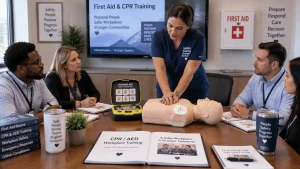
Community CPR classes teach the basics every adult should know. You learn to recognize sudden cardiac arrest, call emergency services, give chest compressions at the right rate and depth, and use an automated external defibrillator. Most cover adult choking relief, and the fuller courses add infant and child CPR and basic first aid.
The American Heart Association offers this level through its Heartsaver line, and the Red Cross runs a similar community course. ASHI, part of the Health and Safety Institute, offers an equivalent that thousands of employers accept. All of them teach lifesaving skills. None is built for the pace of a hospital floor or a code team where multi-rescuer coordination matters.
What BLS Adds on Top
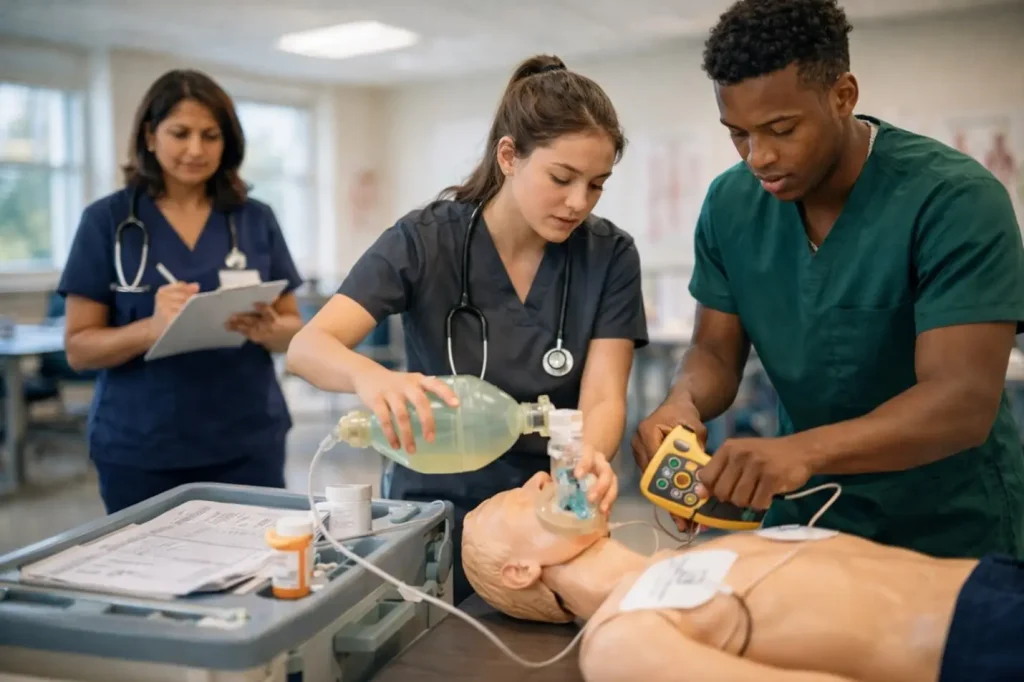
BLS Provider training is built for healthcare workers and people preparing for clinical roles. It covers everything a community class covers, then goes further. Students learn team-based resuscitation with closed-loop communication, bag-valve-mask ventilation across age groups, one-rescuer and two-rescuer ratios, AED coordination during compressions, and the full chain of survival from bystander recognition to hospital handoff.
BLS also holds higher performance standards. Compressions are scored for rate, depth, recoil, and hand position by a certified instructor, not just watched. The exam includes a written test and a hands-on skills check, and failing either means retesting before you get a card.
BLS vs CPR at a Glance
| Factor | Community CPR and First Aid | BLS Provider |
|---|---|---|
| Who it is for | Teachers, coaches, parents, the public | Healthcare workers, clinical staff and students |
| Typical length | 2 to 4 hours | 4 to 6 hours for the initial course |
| Skill depth | Basic CPR, AED, and first aid | Provider CPR, BVM, team dynamics |
| Exam format | Skills check in most cases | Written test plus skills check |
| Card validity | Two years | Two years |
| Employer acceptance | Workplace, childcare, and community roles | Accepted across clinical settings |
| Leads to | No further certifications | Required before ACLS or PALS |
Our Stoughton classes are at the community level: ASHI CPR, AED, and First Aid for workplace, childcare, and caregiving roles. If your employer requires AHA BLS Provider for a hospital or clinical position, you will need a BLS course from a provider that offers it.
Who Should Take BLS
Take BLS if any of these fit. You work in or are applying to a hospital, nursing home, assisted living facility, or home health agency that requires it. You are enrolled in a nursing, dental assistant, or medical assistant program. You are a nurse, LPN, paramedic, EMT, or respiratory therapist. You need a prerequisite for ACLS or PALS. Your licensing board or employer names AHA BLS Provider specifically.
Who Only Needs Community CPR and First Aid
Community CPR and First Aid is the right fit if you are a parent who wants to be ready for a choking toddler, a coach who wants to know what to do at practice, a teacher whose school asks for basic certification, a personal trainer without clinical duties, or any adult who wants the confidence to act in an emergency. Many direct care and home care employers also ask for a current CPR card, so pairing one with home health aide training can make you ready to start sooner. If none of the BLS triggers apply, a community course gives you the skills you need at a lower cost and in less time.
How to Tell Which One Your Employer Wants
Before you enroll, check three things. First, the job description, since many postings list AHA BLS Provider by name. Second, your HR contact or hiring manager, because a quick email saves a costly mistake. Third, your license board or school, since nursing programs and state boards often require provider-level certification with an AHA card.
If a posting says CPR without naming provider-level or AHA, a community CPR card meets it. If it says AHA BLS Provider, a community course will not. When you are unsure and the role is clinical, treat BLS as the safer choice.
What Comes After You Decide
Once you know which class fits, enrolling is simple. Both cards last two years, so note the expiration date and plan your renewal before it lapses. For community-level training close to home, our ASHI CPR and First Aid classes in Stoughton cover the card most workplace, childcare, and caregiving roles ask for, with in-person and hybrid options. Reach out for the next class date and reserve your seat.