Your BLS Provider card is valid for two years, and then the clock runs out. If you work in healthcare across Massachusetts, an expired BLS card can quietly become a serious problem. Some employers pull you off the schedule. Some facility contracts require continuous coverage. Some licensing boards tie renewal timing to your clinical eligibility. This guide walks through exactly when to renew your BLS certification in Massachusetts, how the renewal class differs from initial certification, what it covers, and what happens if you let your card lapse.
When Does Your BLS Card Expire?
Your American Heart Association BLS Provider card is valid for exactly two years from the date of course completion printed on the card itself. The expiration date is not two years from enrollment, not two years from your test date, and not two years from the renewal reminder email. It is two years from completion, and employers verify that exact date before scheduling shifts.
Set a calendar reminder three months before expiration. That window gives you enough time to book a class, complete the renewal, and receive the updated card without any gap in coverage.
Why Renewal Timing Matters
Many Massachusetts healthcare employers check BLS card dates as part of credential audits, shift scheduling, and compliance reviews. An expired card can trigger several outcomes depending on your employer and role. You may be pulled from the schedule until a current card is on file. Your facility may report the lapse during a state survey or accreditation review. Your charge nurse or supervisor may need to cover your shift at the last minute.
Agency-based workers face an even tighter rule. Staffing agencies often run automated credential checks and remove workers from the pool the moment a card expires. Losing a placement because of a 24-hour gap in BLS coverage is an avoidable financial hit.
BLS Renewal Class vs Initial Certification
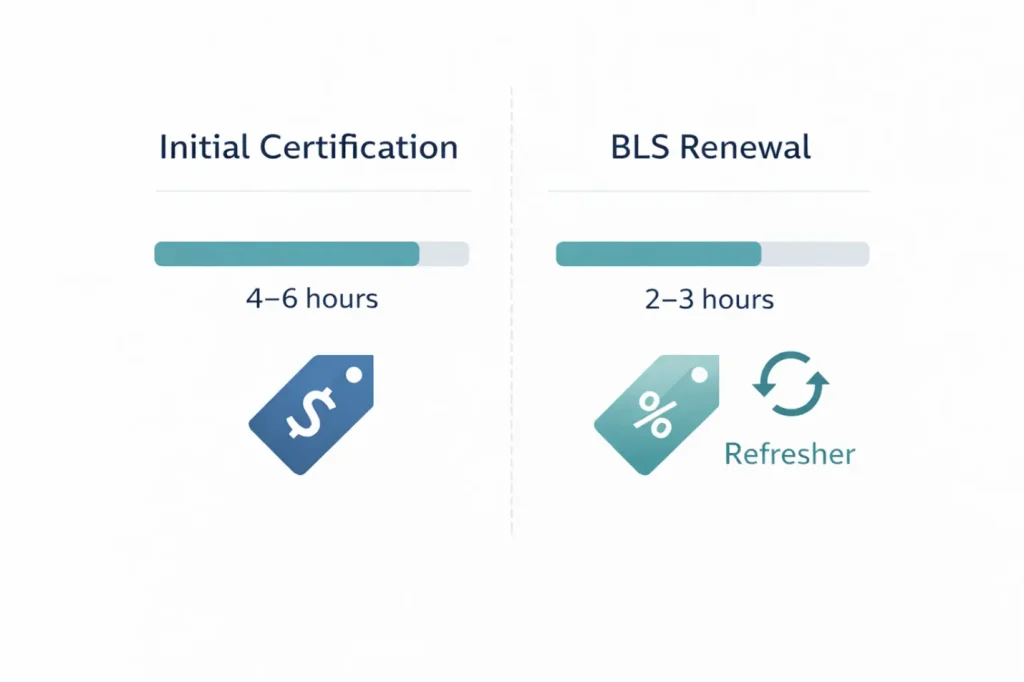
Renewal classes are shorter than initial certification because you already know the core material. Instead of starting from scratch, the renewal format focuses on updated guidelines, skills refresh under instructor observation, and a faster path to the new completion card.
Alt Text: Infographic diagram comparing Initial BLS certification versus BLS Renewal in terms of class length, cost, and requirements.
For a comparison of the two formats, here is a side-by-side summary.
| Factor | Initial BLS Certification | BLS Renewal |
| Who It’s For | First-time BLS candidates | Current card holders within window |
| Typical Length | 4 to 6 hours | 2 to 3 hours |
| Exam Format | Full written plus skills check | Focused refresher plus skills check |
| Cost | Standard initial rate | Lower renewal rate |
| Card Validity | Two years | Two years from renewal date |
What the BLS Renewal Class Covers
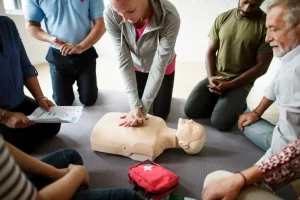
Renewal is not a repeat of the full initial course. The focus is on updates and skills verification. Most renewal classes cover changes to the American Heart Association guidelines since your last certification, any shifts in compression rate or depth recommendations, updates to AED deployment protocols, current choking response sequences for adult, child, and infant patients, and a hands-on skills check with a certified instructor.
You still perform the core skills under observation. The instructor confirms that your compressions meet the required rate and depth, that your ventilation technique is safe, and that your AED deployment is correct. If any skill has slipped, the instructor works with you to bring it back up before the skills check ends.
How to Book Your BLS Renewal
The booking process is simple. Call or email your training center three months before your card expires. Confirm the next available renewal class date. Bring your current BLS card on the day of class. That card is your proof of eligibility for the shorter renewal format.
If your card has already expired or is within days of expiring, most training centers still let you take the renewal class, although some may require you to sit through the full initial certification. Policies vary. Call ahead to confirm. Our Stoughton team can walk you through the right option for your specific situation on our BLS certification page.
What Happens If Your Card Lapses
An expired BLS card is not the end of the world, but it does complicate the path forward. Most training centers will not let you take the renewal class if your card has been expired for more than 30 days. Some are stricter. The safer assumption is that a lapsed card means you retake the full initial certification course rather than the shorter renewal.
On the employment side, most facilities pause your clinical duties the moment they see an expired card. You do not lose your job, but you typically cannot work patient-facing shifts until the card is current again. For per-diem and agency workers, a lapsed card often means lost income because you miss shifts until the new card arrives.
For a refresher on the full BLS process if you need to retake it, see our step-by-step BLS certification guide for Massachusetts.
Pairing BLS Renewal With Other Credentials
Many healthcare workers hold multiple certifications that all renew on two-year cycles. BLS, ACLS, PALS, and some specialty certifications all follow similar timelines. If you carry more than one, try to schedule all renewals in the same month so your credential calendar stays clean and no card catches you off guard.
If you are weighing whether ACLS belongs on your renewal calendar at all, review BLS vs ACLS: Which Certification Fits Your Healthcare Role? to confirm.
Ready to Renew Your BLS Card?
Our Stoughton campus runs BLS renewal classes on flexible weekend and evening schedules designed for working healthcare staff. Book your renewal today and walk out the same day with a fresh two-year card.
Still early in your BLS journey? Read What to Expect in a BLS Class for a preview of class day, or check Who Needs BLS Certification in Massachusetts? to confirm the credential fits your role.