
Choking kills fast. A fully blocked airway cuts oxygen to the brain in seconds, and a person can lose consciousness within a minute if nothing is done. That is why every serious first aid and BLS curriculum covers foreign-body airway obstruction in depth, with age-specific protocols for adults, children, and infants. The technique is not the same across all three groups, and the wrong technique can injure a small patient. Here is the correct response for each age group, how to recognize when the airway is fully blocked, and what to do if the person becomes unresponsive.
How to Recognize Choking
Not every cough is choking. The first job in any suspected choking emergency is recognition. A partly blocked airway produces forceful coughing, wheezing, or noisy breathing. A fully blocked airway produces silence, and the person cannot speak, cough, or breathe effectively. The universal sign is both hands clutched to the throat.
If the person can still cough forcefully, encourage them to keep coughing and do not interfere. The body’s own reflex is often stronger than any outside help. If the cough becomes weak or silent, or the person cannot speak at all, the airway is fully blocked and you act immediately.
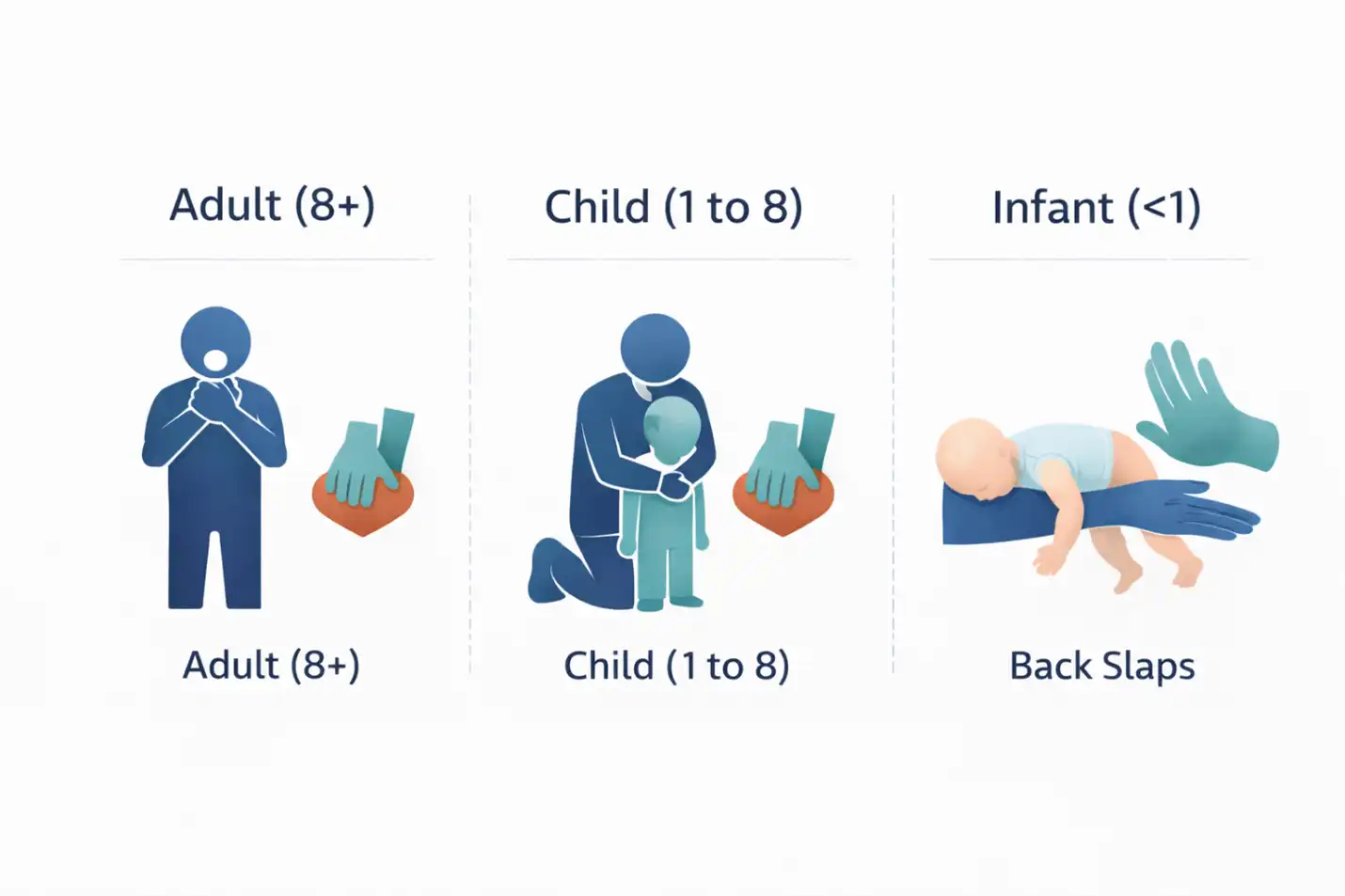
Adult Choking Protocol, Age 8 and Older
Confirm the obstruction first. Ask if the person is choking. If they nod yes and cannot speak, the airway is blocked and you proceed. If they can speak, do not act; encourage coughing and stand ready in case it worsens.
Position yourself directly behind the person. A shorter rescuer helping a taller person needs a stable wide stance for leverage. Wrap your arms around the waist below the rib cage.
Deliver abdominal thrusts. Make a fist with one hand and place the thumb side against the abdomen just above the navel and well below the breastbone. Grasp your fist with the other hand and give quick, upward thrusts. Each thrust is a distinct, forceful motion, not a continuous squeeze. Continue until the object comes out or the person becomes unresponsive.
For pregnant patients, or anyone with a body shape where abdominal thrusts are not practical, use chest thrusts instead. Place your fist on the center of the breastbone and pull straight back toward yourself with each thrust.
Child Choking Protocol, Age 1 to 8
The child protocol is nearly the same as the adult protocol with one important adjustment. Kneel behind the child so your arms wrap at the right height. Match the force to the child’s size, since full adult force on a small child can crack ribs or cause internal injury. Check the mouth after a thrust only if the object becomes visible. Never do a blind finger sweep, because it can push the obstruction deeper.
Infant Choking Protocol, Under Age 1
Infant response is fundamentally different. Abdominal thrusts are never used on infants, because the liver sits high and unprotected under the rib cage and can be seriously injured by that pressure. The infant protocol uses back slaps and chest thrusts in alternating sets.
Position the infant face-down along your forearm with the head lower than the body, resting your forearm on your thigh for stability. Support the infant’s jaw with your hand without pressing on the throat.
Deliver five back slaps. Using the heel of your free hand, give five firm slaps between the shoulder blades. Each is a distinct, forceful motion aimed at expelling the object with the help of gravity.
If it has not cleared, turn the infant face-up along your other forearm, again with the head lower than the body. Place two fingers on the breastbone just below the nipple line and give five chest thrusts, each distinct, downward, and about 1.5 inches deep.
Alternate five back slaps and five chest thrusts until the object comes out or the infant becomes unresponsive. Check the mouth between sets only if you see the object. Never blind sweep an infant’s mouth.
Protocol Comparison by Age
| Factor | Adult (8+) | Child (1 to 8) | Infant (under 1) |
|---|---|---|---|
| Primary technique | Abdominal thrusts | Abdominal thrusts | Back slaps and chest thrusts |
| Force | Full force | Controlled to the child’s size | Gentle, small patient |
| Position | Stand behind | Kneel behind | Along your forearm |
| Hand placement | Above the navel | Above the navel | Between shoulder blades, then breastbone |
| Blind finger sweep | Never | Never | Never |
If the Person Becomes Unresponsive
When a choking victim goes unresponsive, the protocol shifts immediately to CPR. Chest compressions generate higher airway pressures than abdominal thrusts and are more likely to move the obstruction out of a collapsed patient.
For adults and children, lower the person to the ground gently. Call 911 or activate emergency services if you have not already. Begin chest compressions: adults at a compression-to-breath ratio of 30 to 2, with a rate of 100 to 120 per minute and a depth of at least 2 inches. For children, single-rescuer CPR uses the same 30 to 2 ratio, and two-rescuer CPR uses 15 to 2. Before each set of rescue breaths, look in the mouth and remove any visible object with a finger. If you do not see it, continue with breaths and more compressions. For infants, place the baby on a firm, flat surface and begin infant CPR: 30 to 2 with one rescuer, 15 to 2 with two rescuers, at 100 to 120 per minute, compressing about 1.5 inches deep. Same rule on the mouth check, look before every breath, remove only what you can see.
For the full CPR sequence and how a class walks you through it, see what to expect in a BLS class.
After the Airway Clears
Even when the airway clears, every choking victim should be evaluated by a medical professional. Abdominal thrusts can cause internal injury that is not obvious at first. Chest thrusts can fracture ribs. Small pieces of the obstruction may still sit in the lower airway. A short emergency department visit rules out complications and gives the person peace of mind.
Practice These Skills in a First Aid Class
Reading the protocols is a start. Doing them under pressure calls for hands-on practice on manikins, with instructor feedback and enough repetition that the technique becomes automatic. Our Stoughton CPR and First Aid classes cover choking response for all three age groups alongside compressions, rescue breathing, and AED use. If your role calls for provider-level BLS with a hospital or clinical employer, a BLS Provider course from a program that offers it is what you will need instead, and the differences are laid out in BLS vs CPR. To see how the AED fits into a cardiac arrest response alongside these skills, read the AED use step-by-step guide.