You already know you need a BLS Provider card. The next question is which organization should issue it. The American Heart Association and the American Red Cross both offer Basic Life Support certifications for healthcare workers, and from a distance they look similar. Look closer, and the differences start to matter, especially in Massachusetts. Employer acceptance, curriculum format, card recognition, and even enrollment options vary between the two. This guide walks through exactly how AHA and Red Cross BLS compare, which one Massachusetts employers prefer, and where to enroll in AHA BLS near Stoughton without wasting time on the wrong credential.
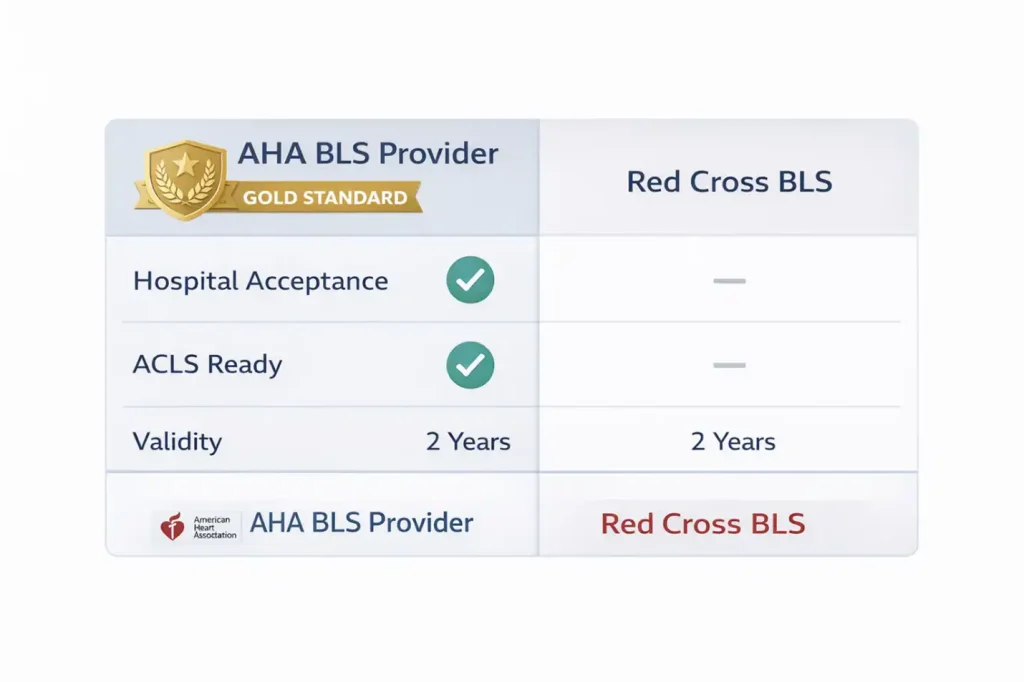
Alt Text: Infographic comparing AHA vs Red Cross BLS certification on hospital acceptance, curriculum, and advanced course compatibility in Massachusetts.
Quick answer: Across Massachusetts hospitals, long-term care facilities, dental offices, and home health agencies, American Heart Association BLS Provider is the default expectation. Enrolling in the wrong certification means paying twice when your employer rejects the card.
The Short Answer Most Massachusetts Students Need
For most healthcare roles in Massachusetts, the American Heart Association BLS Provider certification is the safer pick. It is the gold standard across hospitals in Boston, Brockton, Quincy, and the entire Greater Boston area. Job postings that specify an issuing organization almost always name the AHA by default. Red Cross BLS is a valid certification and a respected credential, but acceptance outside the healthcare network is narrower, and many Massachusetts employers specifically require an AHA card during hiring.
If you are uncertain which one your employer wants, the AHA path reduces the risk of a wasted enrollment. Red Cross is fine when your employer specifically accepts it, but it rarely wins in the reverse scenario.
Still choosing between BLS and basic CPR? Read BLS vs CPR: What’s the Difference and Which One Do You Need? first to confirm BLS is the right category.
What AHA BLS Certification Covers
The American Heart Association is the organization that publishes the underlying science used in resuscitation training across the United States. Every two years the AHA releases updated CPR and Emergency Cardiovascular Care guidelines, and those guidelines form the baseline for most provider-level courses worldwide, including many Red Cross materials.
An AHA BLS Provider course trains you to recognize cardiac arrest, deliver high-quality chest compressions across age groups, use an automated external defibrillator, perform effective ventilations with a bag-valve-mask device, relieve choking in adults, children, and infants, and work as part of a multi-rescuer team during a code. The card that results is valid for two years and carries the AHA branding that hospital HR systems recognize automatically.
What Red Cross BLS Certification Covers
The American Red Cross also offers a BLS for Healthcare Providers course covering the same core skills. Curriculum depth is similar because both organizations pull from the International Liaison Committee on Resuscitation consensus that the AHA itself helps publish. Red Cross students learn CPR, AED deployment, airway obstruction relief, and team-based resuscitation using updated guidelines.
Red Cross BLS is a good fit for students whose employer specifically accepts or prefers Red Cross credentials, for organizations that have existing Red Cross training contracts, and for rural areas where AHA instructor availability is limited. The course delivers the same life-saving skills and produces a two-year card.
AHA vs Red Cross BLS at a Glance
Here is the cleanest comparison across the factors Massachusetts students actually weigh before enrolling.
| Factor | AHA BLS Provider | Red Cross BLS |
| Issuing Body | American Heart Association | American Red Cross |
| Curriculum Source | Publishes the baseline guidelines | Aligned with similar guidelines |
| MA Hospital Acceptance | Accepted across the board | Accepted by most, not all |
| Dental Office Acceptance | Default standard | Varies by practice |
| ACLS Prerequisite | Required for AHA ACLS | May not meet AHA ACLS entry rules |
| Card Validity | Two years | Two years |
| Training Center Density in MA | Wide across the state | Narrower network |
Why Massachusetts Employers Lean Toward AHA
Hospital credentialing systems, nursing licensure applications, and dental office hiring forms across Massachusetts often list AHA BLS Provider as the default option. Part of this is historical. The AHA has been the dominant issuer of provider-level resuscitation credentials for decades, and HR systems built around that expectation rarely change unless a specific employer policy demands otherwise.
Another part is pipeline alignment. An AHA BLS card flows directly into AHA ACLS, AHA PALS, and other advanced courses without compatibility concerns. For healthcare workers planning a career path, that compatibility matters. A nursing student with an AHA BLS card can enroll in AHA ACLS the moment the job demands it. A student with Red Cross BLS sometimes needs to retake the provider course with AHA before accessing AHA ACLS, depending on the specific training center and employer policy.
For a deeper look at that next credential, read BLS vs ACLS: Which Certification Fits Your Healthcare Role?.
When Red Cross BLS Makes Sense
Red Cross BLS is the right pick in specific scenarios. If your employer has an established Red Cross training contract and specifically accepts or prefers Red Cross cards, go that route. If you already hold other Red Cross certifications and want to consolidate your credential provider, consistency has value. If an AHA class is not scheduled in your area and waiting would push back your job start date, a Red Cross class can bridge the gap.
Outside of those scenarios, the AHA path typically offers more flexibility for healthcare workers in Massachusetts.
How to Verify Which One Your Employer Wants
Before enrolling in any BLS class, check three sources. One, the job posting or offer letter. Many Massachusetts postings specifically list AHA BLS Provider. Two, your HR contact or credentialing coordinator. A short email confirms the exact requirement. Three, your facility’s onboarding checklist, which often names the preferred issuer by organization.
If any of those sources specify AHA, do not settle for Red Cross. If any of them accept both, AHA remains the more flexible choice because it opens more doors later in your career.
Why Massachusetts Students Choose One Health and Beyond for AHA BLS
When you search for AHA BLS training near Stoughton, you have options. Large hospital systems run internal classes that fill up fast. Independent instructors rent space week to week. National chains offer online-heavy blended formats. What sets One Health and Beyond apart is the combination of clinical expertise, local access, and hands-on instruction that matches the pace of a real Massachusetts healthcare floor.
Here is what you get when you enroll in our AHA BLS Provider course in Stoughton.
✓ Clinician-Led Instruction. Our program is led by Dr. Jocelyne Destine, FNP-C, PMHP-C, DNP, a Family Nurse Practitioner and Doctor of Nursing Practice with more than a decade of clinical experience. You learn the skills the way a practicing provider actually uses them, not the way a textbook describes them.
✓ AHA-Aligned, Not Generic CPR. Our curriculum reflects the 2025 American Heart Association Guidelines for CPR and Emergency Cardiovascular Care. The completion card you receive is recognized by Massachusetts hospitals, nursing homes, dental offices, and home health agencies on sight.
✓ Stoughton Campus, Greater Boston Access. Located in Stoughton (ZIP 02072), our campus serves students from Brockton, Randolph, Canton, Sharon, Quincy, and the broader Greater Boston area. No long commutes, no city parking headaches.
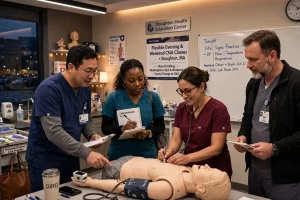
✓ Flexible Evening and Weekend Classes. Built around the schedules of working adults, CNAs finishing their core programs, and career changers balancing family and training. Complete your initial BLS certification in a single day.
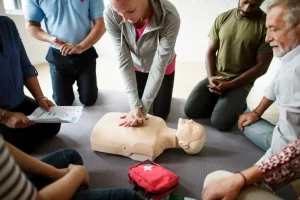
✓ Small Class Sizes for Real Hands-On Time. Every student gets actual practice time with manikins and AED trainers, not front-row viewing of someone else practicing. Instructors have time to coach you one-on-one if a specific skill needs more work.
✓ Same-Day Completion Card. Walk in without certification, walk out with your AHA BLS Provider card and the confidence to list it on your next job application the same day.
For a full walkthrough of what to expect in class, read our step-by-step BLS certification guide for Massachusetts or see the what to expect in a BLS class breakdown.
Frequently Asked Questions
Is AHA BLS accepted at Massachusetts hospitals?
Yes. AHA BLS Provider is the default credential accepted across Massachusetts hospitals, skilled nursing facilities, dental offices, and home health agencies. HR credentialing systems are built around the AHA card, and most hiring forms list it by name.
Where can I take AHA BLS certification near Stoughton, MA?
Our Stoughton campus at One Health and Beyond offers AHA BLS Provider classes on flexible evening and weekend schedules. Students come from Stoughton, Brockton, Randolph, Canton, Sharon, Quincy, and the Greater Boston area.
Can I switch from Red Cross BLS to AHA BLS later?
Yes, but it usually means retaking the full BLS Provider course with AHA rather than a shorter renewal. Most students who switch do so after an employer specifies AHA during hiring. To avoid the double enrollment, choose AHA the first time.
How long does it take to complete AHA BLS certification?
Initial AHA BLS certification takes 4 to 6 hours in a single day. Renewal is shorter at 2 to 3 hours. Our Stoughton campus offers both initial and renewal classes on flexible schedules.
Is One Health and Beyond’s BLS course AHA-aligned?
Yes. Our BLS Provider course reflects the 2025 American Heart Association Guidelines for CPR and Emergency Cardiovascular Care. The completion card you receive is the AHA-aligned credential recognized by Massachusetts healthcare employers.
Ready to Enroll in AHA BLS in Stoughton?
Skip the employer rejection risk and enroll in the credential most Massachusetts healthcare employers already accept. Our next AHA BLS Provider class in Stoughton is filling up, and seats are limited by design so every student gets real hands-on time. See current class dates and reserve your seat today.
Still researching? Confirm your role fits the BLS category in our who needs BLS certification in Massachusetts guide or review how BLS stacks with your existing credentials in BLS certification for CNAs and HHAs.